Mohs Surgery for Melanoma
Melanoma arises from the skin's pigment cells and is the most serious of the common skin cancers, because it can spread if it is not treated early. It usually announces itself as a mole that changes — in size, shape, or color — or a new spot that stands out from the rest.
For appropriate melanomas, we offer what few practices can: same-day, margin-controlled Mohs surgery with immunohistochemical staining — MART-1 and SOX10 — run in our own laboratory. The cancer is removed, every margin is tested, and once the margins are clear the wound is reconstructed, all in one visit. Wide local excision remains the right operation for some melanomas, and when a deeper melanoma calls for sentinel lymph node evaluation or additional specialists, we coordinate that care.
Margins matter most where melanoma hides. Melanoma in situ — especially the lentigo maligna type on the head, neck, and other sun-damaged skin — often extends invisibly beyond its visible edge. A conventional excision removes a fixed margin and waits days for the laboratory to say whether it was enough; sometimes it was not. Mohs replaces that uncertainty with a measurement: one hundred percent of the margin is examined, with immunostains that make even single melanoma cells visible, before anything is reconstructed. On the face, that same precision spares healthy tissue a wider blind margin would sacrifice.
This approach is well studied. Peer-reviewed series of Mohs surgery for melanoma performed with MART-1 immunostaining report local recurrence rates below one percent, and large registry studies have found survival after Mohs at least equal to conventional wide excision, with several reporting a modest advantage for early melanoma that has not yet been confirmed in prospective trials.
Your surgeon will recommend the approach that fits your melanoma — its depth, its location, and you.
A selection of the literature appears below ↓
(972) 378-0620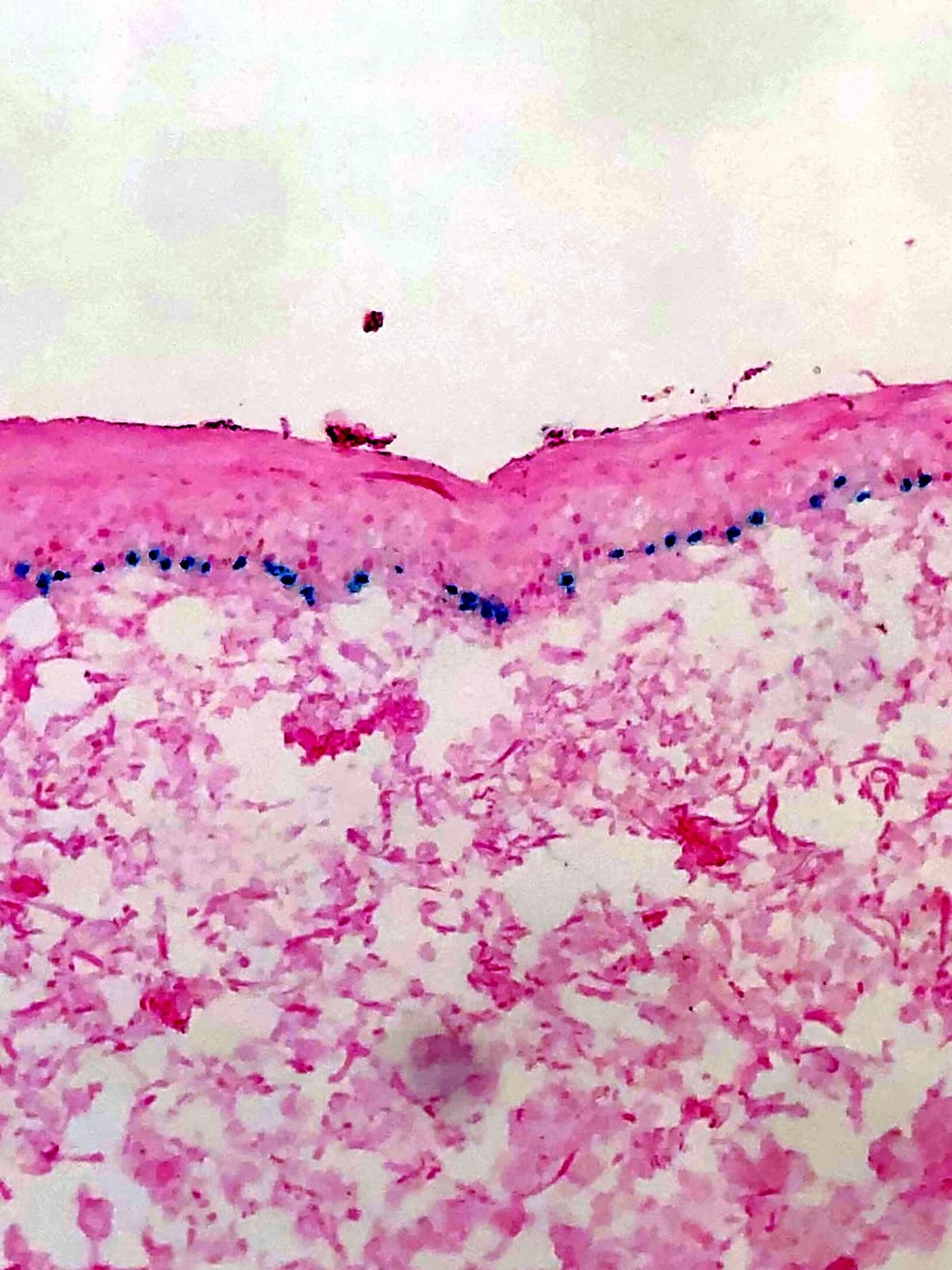
When to come in
- A mole changing in size, shape, or color
- A spot with irregular borders or multiple colors
- A new or changing spot that stands out from your other moles
- A biopsy-confirmed melanoma referred for surgery
How we treat it
Same-day Mohs surgery with immunostains
MART-1 and SOX10 staining in our own laboratory — margin-controlled, tissue-sparing removal for appropriate melanomas.
Wide local excision
The standard operation for melanomas where conventional margins are the right approach.
Coordinated escalation when indicated
Sentinel lymph node evaluation and referrals to medical oncology, arranged and followed by our team.
Your surgeon will walk you through what to expect — including preparation and aftercare — before anything is scheduled.
See also: Mohs surgery, in detail
Further reading: Is a Base Tan Protective? Does a Tanning Bed Once a Week Matter? · Do I Need Sunscreen in the Car or Indoors by a Window? · My Biopsy Says ‘Atypical Mole.’ Is That Cancer? · Should You Put Hydrogen Peroxide or Rubbing Alcohol on a Cut? · Steri-Strips: When Do They Come Off, and Can I Remove Them Myself? · Should You Cover a Wound or Let It Breathe? · How Do I Know If My Stitches Are Infected? · Can Stitches Get Wet? When Can I Shower or Swim? · Can You Put Neosporin on Stitches? · Can Mohs Surgery Be Used for Melanoma? · Should You Put Neosporin on a Wound? · I Just Had a Melanoma. What Are My Odds of Getting Another One? · Is There Such a Thing as a Safe Amount of Sun?
Mohs for melanoma is well-studied and validated
For colleagues — and patients who want the data behind the approach.
- Cheraghlou S, et al. Comparison of survival after Mohs micrographic surgery vs wide margin excision for early-stage invasive melanoma. JAMA Dermatology. 2019;155(11):1252-1259. (opens in new tab)
- Nosrati A, et al. Outcomes of melanoma in situ treated with Mohs micrographic surgery compared with wide local excision. JAMA Dermatology. 2017;153(5):436-441. (opens in new tab)
- Etzkorn JR, et al. Low recurrence rates for in situ and invasive melanomas using Mohs micrographic surgery with MART-1 immunostaining. Journal of the American Academy of Dermatology. 2015;72(5):840-850. (opens in new tab)
- Valentin-Nogueras SM, et al. Mohs micrographic surgery using MART-1 immunostain in the treatment of invasive melanoma and melanoma in situ. Dermatologic Surgery. 2016;42(6):733-744. (opens in new tab)
- Bricca GM, et al. Cutaneous head and neck melanoma treated with Mohs micrographic surgery. Journal of the American Academy of Dermatology. 2005;52(1):92-100. (opens in new tab)
- Kunishige JH, Brodland DG, Zitelli JA. Surgical margins for melanoma in situ. Journal of the American Academy of Dermatology. 2012;66(3):438-444. (opens in new tab)
Related procedures
Basal Cell Carcinoma
The most common skin cancer — slow to spread, but destructive locally. Mohs offers the most precise removal.
Read moreSquamous Cell Carcinoma
The second most common skin cancer — treated promptly because it can spread. High-risk tumors get immunostained margin control.
Read moreNail Procedures & Nail Biopsies
Nail matrix surgery and nail-unit biopsies — including evaluation of streaks and growths under the nail.
Read moreRequest a Consultation
Talk to us about this procedure
Call the office and we will find a time that works.
(972) 378-06206100 Windhaven Parkway, Plano, TX 75093 · Mon-Thurs: 7:30-4 | Fri: 10-2