Should You Cover a Wound or Let It Breathe?
Medically reviewed by Gunjan Modi, MD, FAAD, FACMS, board-certified dermatologist and fellowship-trained Mohs surgeon · Updated October 2, 2026
The short answer
It depends on the kind of wound. For a scrape, a biopsy site, or a wound left open to heal on its own, research points toward keeping it moist and covered rather than letting it dry and scab. That research is mostly in animals, plus one study of biopsy sites in patients, where covered sites were more likely to be healed, and hurt less, than sites given usual care. "Letting it breathe" has little research behind it. For everyday cuts, dermatologists advise a thin layer of plain petroleum jelly under a non-stick bandage. A stitched incision is a different question. Trials that compared covered and uncovered stitched wounds found little difference in infection, though the trials were small, and surgeons reasonably give different instructions. This page is general education. Follow the instructions from the surgeon who treated you.
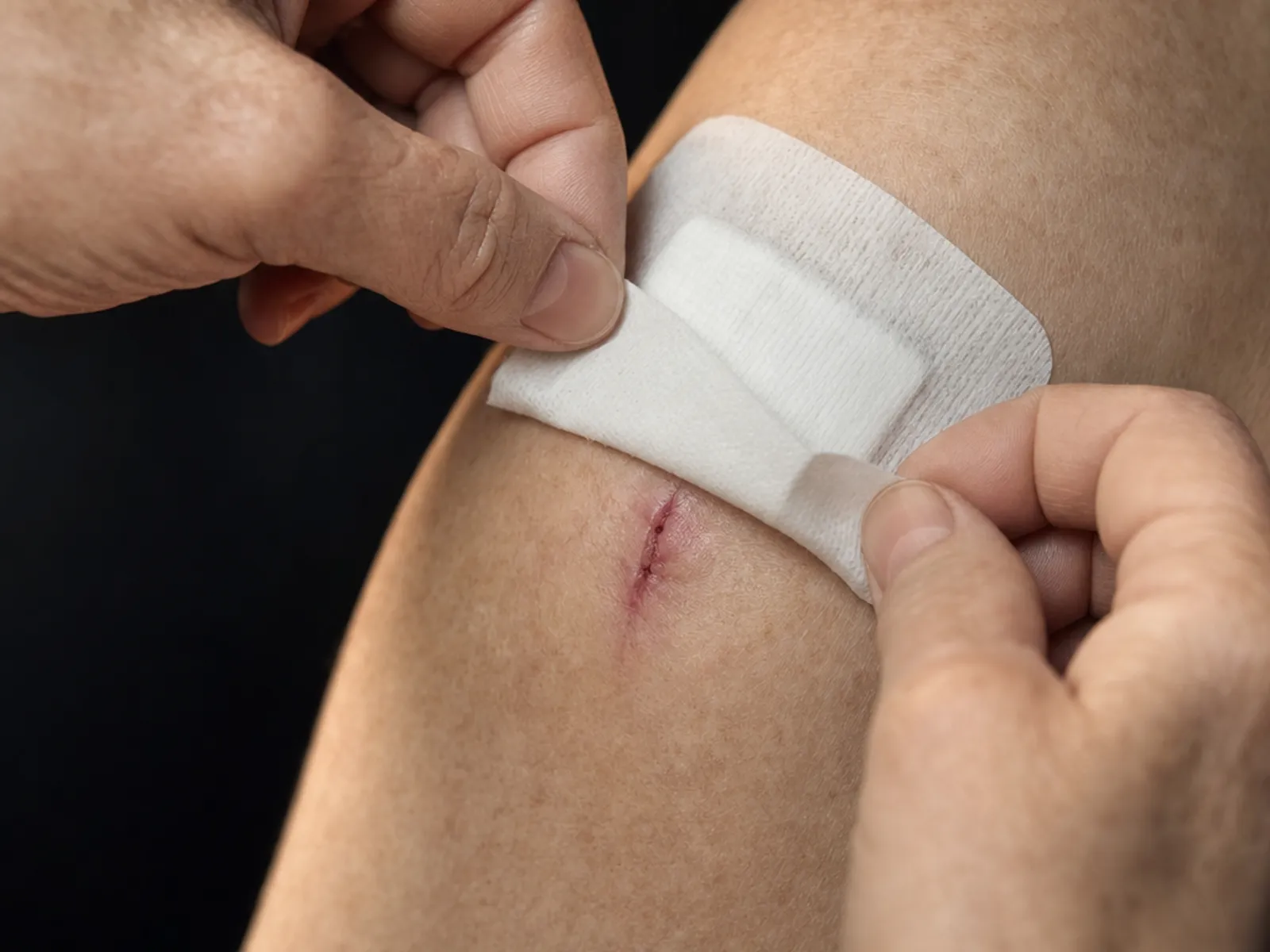
It depends on what kind of wound you have
Most of the research behind "keep it covered" is about open wounds: a scrape, a shave or punch biopsy site, or a surgical wound the surgeon has left open to heal in from the sides. For those wounds, the studies point one way. In animals, wounds kept moist under a sealed dressing grew new skin faster. In patients, biopsy sites kept under a moist dressing were more likely to be healed, and less likely to hurt, than sites given usual care. For everyday cuts, dermatologists advise a thin layer of plain petroleum jelly under a non-stick bandage. "Letting it breathe" has little research behind it.
A wound closed with stitches is a different question. Its edges are already touching, and trials that compared covered and uncovered stitched wounds found little difference in infection. Surgeons give different instructions for stitched wounds, and for good reasons: the closure, the location, and the patient all matter. This page explains what the research shows. It is not a set of instructions. For your own wound, follow the instructions from the surgeon who treated you.
Where "keep it moist" came from
The idea comes from animal experiments. In a 1978 study in pigs, superficial wounds healed 40 percent faster when sealed under a plastic film than when they were not. A 1983 study from the same research group, also in pigs, found more new collagen and faster regrowth of the skin surface under sealed dressings. The regrowth was faster under a film that blocked oxygen as well as under one that let it through, suggesting that the benefit comes from moisture rather than from air reaching the wound.
The same 1983 study found that, when the dressings were removed, a wet-to-dry gauze dressing and one of the two sealed dressings often tore the new skin. That is the reason for a non-stick pad.
These are animal studies. They explain the idea. They do not prove what happens to a particular wound on a particular person, and as the sections below show, the human trials are less tidy.
What happened in patients: biopsy sites and everyday cuts
The closest human study, published in 1991, followed 174 patients with 226 unstitched biopsy sites, shave biopsies and 3-millimeter punch biopsies. Sites cared for with a sealed dressing were compared with sites given conventional care. Covered shave biopsy sites were more likely to be healed at the check-up. Of the punch biopsy sites, 36 percent had healed at two weeks with the sealed dressing and 7 percent with conventional care. Pain was six times more common with conventional care. Of the 40 patients who had sites cared for both ways, three in four preferred the sealed dressing, because it was easier and hurt less.
The study has limits. It was a prospective study, and the published summary does not describe random assignment or spell out what conventional care involved. No confidence intervals were reported, and most punch sites had not healed at two weeks either way. One site in each group had an infection or a suspected infection, which says nothing about infection risk. The fair reading is that covered biopsy sites were more likely to be healed and less likely to hurt, not that covering was proved to heal every wound faster.
For everyday cuts and scrapes, the American Academy of Dermatology's patient pages give the same advice: apply petroleum jelly to keep the cut moist, cover it with a sterile bandage, change the bandage daily, and keep it covered until it heals. The pages add that a wound that forms a scab takes longer to heal, and for minor cuts they say, in their words, "Do not apply topical antibiotics." That is advice for minor cuts from dermatologists, not a graded guideline and not instructions for a surgical wound.
Figure
Open biopsy wounds: healed at two weeks, covered versus not
A 1991 study of 174 patients with 226 unstitched biopsy wounds compared two ways of caring for the sites. The bars show the share of 3-millimeter punch biopsy sites that had healed at two weeks. It was a prospective comparison; the published summary does not describe random assignment.
Data: Nemeth AJ, Eaglstein WH, Taylor JR, Peerson LJ, Falanga V. Faster healing and less pain in skin biopsy sites treated with an occlusive dressing. Archives of Dermatology. 1991;127(11):1679–1683. Covered sites were more likely to be healed at the check-up, and pain at the biopsy site was six times more common with conventional care. No confidence intervals were published, the summary does not spell out what conventional care involved, and most punch sites had not healed at two weeks either way. What this means: for a small open wound, keeping it covered made healing at two weeks more likely and pain less likely in this study. It says nothing about wounds closed with stitches. This figure is our own drawing of the published numbers.
See the numbers as a table
| Care | Healed at two weeks |
|---|---|
| Covered with a sealed dressing, occlusive dressing therapy | 36% |
| Conventional care, as the clinic usually managed biopsy sites | 7% |
A stitched incision is a different question
When a wound is closed with stitches, the skin edges are brought together and held, so there is no open surface for new skin to grow across. Whether a bandage still helps after the first day or two is a question the trials have not settled.
A 2016 Cochrane review of dressings for stitched surgical wounds pooled 29 randomized trials with 5,718 participants, though only four of the trials compared a dressing with no dressing at all. Its conclusion: it is uncertain whether covering a stitched wound with any dressing reduces or increases the risk of infection, and uncertain whether any one dressing beats another. The certainty of the evidence was very low for most comparisons and low for the rest.
Two other Cochrane reviews looked at taking the bandage off early. In a trial of 857 patients with minor skin excisions in Australian general practice, 415 removed the dressing after 12 hours and bathed normally, and 442 kept the wound dry and covered for 48 hours. The trial report found infection in 8.4 percent of the early group and 8.9 percent of the covered group and called the early approach non-inferior. Cochrane's re-analysis of the same trial, which is what the figure shows, and a separate Cochrane review of three small trials in 280 surgical patients both found no clear difference. The Cochrane authors rated these trials at high risk of bias and said a real difference in either direction could not be ruled out.
Figure
Stitched wounds only: does taking the bandage off early raise the risk of infection?
Each row is a risk ratio from a Cochrane review of randomized trials: the infection rate when the dressing came off early, divided by the rate when it stayed on. A value below 1.0 would mean fewer infections after early removal; above 1.0, more. The whisker is the 95% confidence interval, the range the true answer is likely to fall in.
Bandage off within 48 hours, compared with left on longer
3 small trials, 280 people after planned surgery; superficial infection within 30 days
Bandage off after 12 hours with normal bathing, compared with kept on and dry for at least 48 hours
1 trial, 857 minor skin excisions; wound infection (Cochrane re-analysis)
Data: Toon CD, et al. Early versus delayed dressing removal after primary closure of clean and clean-contaminated surgical wounds. Cochrane Database of Systematic Reviews. 2015;(9):CD010259 (three trials, 280 people, rated very low quality evidence); and Toon CD, et al. Early versus delayed post-operative bathing or showering to prevent wound complications. Cochrane Database of Systematic Reviews. 2015;(7):CD010075, a re-analysis of one trial of 857 minor skin excisions in Australian general practice (Heal C, et al. BMJ. 2006;332:1053–1056) that Cochrane rated at high risk of bias. Both ranges cross 1.0, so a higher or a lower infection risk is still possible; wide ranges mean the studies were too small to tell. These studies looked only at wounds closed with stitches. They say nothing about scrapes or wounds left open to heal. What this means: for a stitched wound, research has not shown that keeping a bandage on longer prevents infection, or that taking it off early causes infection. Your surgeon’s instructions decide. This figure is our own drawing of the published numbers.
See the numbers as a table
| Comparison | People | Outcome | Risk ratio (95% CI) | Source |
|---|---|---|---|---|
| Dressing removed within 48 hours vs. kept on beyond 48 hours | 280 (3 trials) | Superficial surgical-site infection within 30 days | 0.64 (0.32 to 1.28) | Toon 2015, CD010259 |
| Dressing removed after 12 hours with normal bathing vs. kept on and dry for at least 48 hours | 857 (1 trial, Heal 2006) | Surgical-site infection | 0.96 (0.62 to 1.48) | Toon 2015, CD010075 |
The evidence that cuts the other way
One randomized trial is often quoted against moist dressings, and it deserves a fair reading. In Amsterdam, 285 hospitalized surgical patients with open wounds were assigned to modern sealed dressings (foams, alginates, hydrogels, hydrocolloids, hydrofibers, or films) or to gauze until the wound healed. Overall, time to complete healing was not significantly different: a median of 66 days with sealed dressings and 45 days with gauze. In the wounds that followed an operation, 62 percent of the wounds in the trial, gauze healed faster: a median of 45 days against 72. Pain scores during dressing changes were low and similar in both groups.
Two things keep this result in proportion. Gauze is still a covering, so the trial compared two ways of covering a wound, not covering against airing. And these were large hospital wounds healing over months, not the small outpatient wounds most of this page is about. A 2004 Cochrane review of 13 trials of dressings for surgical wounds left open to heal reached a similar place: the trials were too small and too weak to say whether the choice of dressing changes healing, though gauze was more painful than other dressings in four trials and patients liked it less in three.
The lesson is that moist is not the same as soaked. A thin layer of ointment, and a dressing changed when it is wet or dirty, is the general dermatology advice. Which dressing suits your wound is your surgeon's call.
Won't covering a wound trap bacteria?
Bacteria do grow under a bandage. The question is whether that leads to more infections, and the studies have not found that it does. A 1990 review pooled infection counts from published dressing studies and found fewer infections under sealed dressings than under gauze-type dressings. Read it with care: it was a literature review, not a trial; it pooled unlike wounds; it compared sealed dressings with other dressings rather than with bare skin; and its first author worked for a dressing manufacturer. It shows that sealing a wound did not cause a wave of infections, and no more than that.
The large trials of stitched skin-surgery wounds point the same way. In a trial of 1,801 stitched wounds kept under a sealed dressing, the infection rate was between 1.4 and 2.3 percent. In a trial of 922 dermatologic surgery patients using plain petrolatum or bacitracin ointment after surgery, 1.5 percent developed an infection. For stitched wounds, as the section above explains, it is uncertain whether a dressing changes infection risk in either direction. Infections still happen under bandages, and a bandage is not a treatment for a wound that is already infected. If a wound looks infected, call the surgeon who treated you.
Do you need antibiotic ointment under the bandage?
The ointment's job is to keep the wound from drying out. Whether it needs an antibiotic in it is a separate question, and the trials do not all agree. In the 922-patient trial, infection occurred in 2.0 percent of patients using plain white petrolatum and 0.9 percent using bacitracin, a difference that was not statistically significant. No patient using petrolatum developed an allergic rash, against four using bacitracin, a difference that was also not significant. One secondary finding went the other way: eight infections in the petrolatum group, 1.8 percent, were due to staph bacteria, against none in the bacitracin group. In the 1,801-wound trial, no ointment, plain paraffin ointment, and prescription mupirocin under a sealed dressing gave infection rates of 1.4, 1.6, and 2.3 percent, and the authors concluded that mupirocin was not indicated for clean surgical wounds.
Surgeons still differ, and the evidence allows it. A later trial of 972 patients with higher-risk stitched wounds found that a single application of a topical antibiotic lowered infection from 11.0 to 6.6 percent, a reduction its authors called statistically but not clinically significant. If your surgeon prescribed an ointment, use that one. For why many dermatologists prefer plain petroleum jelly over Neosporin, read Should You Put Neosporin on a Wound? and, for stitched wounds, Can You Put Neosporin on Stitches?.
Airing it out at night, special dressings, and when to call
No study in this body of research tested letting a wound air out at night, or for any set number of hours a day, and none found a benefit from doing so. Each time an open wound dries, the moist surface that new skin cells move across is lost and a scab starts to form. So the useful question is not how long to air a wound out, but how long to keep it covered. That is your surgeon's call, because it depends on the wound and on how it was repaired.
Some wounds have special dressings. A skin graft or flap may have a bolster or pressure dressing stitched or taped in place. These are not meant to be changed at home and should not be removed or loosened unless the surgeon says so. If you are not sure which kind of dressing you have, call before you touch it.
Most wounds heal without trouble. Call the surgeon who treated you if you notice any of the following:
- Redness that spreads beyond the edge of the wound
- Pain that increases after the first two to three days instead of easing
- Pus or cloudy drainage
- Fever
This page is general education and should not be construed as medical advice. Open wounds, stitched wounds, grafts, and flaps are cared for differently, and surgeons reasonably give different instructions. Always follow the instructions from the surgeon who treated you. If we treated your wound and you have a question about how to care for it, call us at (972) 378-0620.
Common questions
Answers reflect the general case — a physician who can see the wound always beats a page that cannot.
Selected peer-reviewed literature
The data behind the answer.
- Eaglstein WH, Mertz PM. New methods for assessing epidermal wound healing: the effects of triamcinolone acetonide and polyethelene film occlusion. Journal of Investigative Dermatology. 1978;71(6):382–384. (opens in new tab)
- Alvarez OM, Mertz PM, Eaglstein WH. The effect of occlusive dressings on collagen synthesis and re-epithelialization in superficial wounds. Journal of Surgical Research. 1983;35(2):142–148. (opens in new tab)
- Nemeth AJ, Eaglstein WH, Taylor JR, Peerson LJ, Falanga V. Faster healing and less pain in skin biopsy sites treated with an occlusive dressing. Archives of Dermatology. 1991;127(11):1679–1683. (opens in new tab)
- Hutchinson JJ, McGuckin M. Occlusive dressings: a microbiologic and clinical review. American Journal of Infection Control. 1990;18(4):257–268. (Pooled literature review; first author affiliated with a dressing manufacturer.) (opens in new tab)
- Dumville JC, Gray TA, Walter CJ, et al. Dressings for the prevention of surgical site infection. Cochrane Database of Systematic Reviews. 2016;12:CD003091. (opens in new tab)
- Toon CD, Lusuku C, Ramamoorthy R, Davidson BR, Gurusamy KS. Early versus delayed dressing removal after primary closure of clean and clean-contaminated surgical wounds. Cochrane Database of Systematic Reviews. 2015;(9):CD010259. (opens in new tab)
- Toon CD, Sinha S, Davidson BR, Gurusamy KS. Early versus delayed post-operative bathing or showering to prevent wound complications. Cochrane Database of Systematic Reviews. 2015;(7):CD010075. (opens in new tab)
- Heal C, Buettner P, Raasch B, et al. Can sutures get wet? Prospective randomised controlled trial of wound management in general practice. BMJ. 2006;332(7549):1053–1056. (opens in new tab)
- Ubbink DT, Vermeulen H, Goossens A, Kelner RB, Schreuder SM, Lubbers MJ. Occlusive vs gauze dressings for local wound care in surgical patients: a randomized clinical trial. Archives of Surgery. 2008;143(10):950–955. (opens in new tab)
- Vermeulen H, Ubbink D, Goossens A, de Vos R, Legemate D. Dressings and topical agents for surgical wounds healing by secondary intention. Cochrane Database of Systematic Reviews. 2004;(2):CD003554. (opens in new tab)
- Smack DP, Harrington AC, Dunn C, et al. Infection and allergy incidence in ambulatory surgery patients using white petrolatum vs bacitracin ointment: a randomized controlled trial. JAMA. 1996;276(12):972–977. (opens in new tab)
- Dixon AJ, Dixon MP, Dixon JB. Randomized clinical trial of the effect of applying ointment to surgical wounds before occlusive dressing. British Journal of Surgery. 2006;93(8):937–943. (opens in new tab)
- Heal CF, Buettner PG, Cruickshank R, et al. Does single application of topical chloramphenicol to high risk sutured wounds reduce incidence of wound infection after minor surgery? Prospective randomised placebo controlled double blind trial. BMJ. 2009;338:a2812. (opens in new tab)
- American Academy of Dermatology. How to treat minor cuts (patient page, updated February 2022); Minimize a scar: proper wound care tips from dermatologists. (opens in new tab)
If a spot will not heal
A wound that never quite closes is one of the ways skin cancer first announces itself. Diagnosing and removing skin cancer is what this practice does all day, every day.
Basal Cell Carcinoma
The most common skin cancer — slow to spread, but destructive locally. Mohs offers the most precise removal.
Squamous Cell Carcinoma
The second most common skin cancer — treated promptly because it can spread. High-risk tumors get immunostained margin control.
Mohs Surgery for Melanoma
The most serious common skin cancer — treated here with same-day, margin-controlled Mohs surgery for appropriate cases.
Request a Consultation
A question about a spot that worries you?
Call us, or send an appointment request — requests receive a call back within one business day.
(972) 378-06206100 Windhaven Parkway, Plano, TX 75093 · Mon-Thurs: 7:30-4 | Fri: 10-2