Is a Base Tan Protective? Does a Tanning Bed Once a Week Matter?
Medically reviewed by Gunjan Modi, MD, FAAD, FACMS, board-certified dermatologist and fellowship-trained Mohs surgeon · Updated October 3, 2026
The short answer
A base tan is real color, but it is not protection. A tan is pigment the skin makes in response to damage from ultraviolet light; the CDC calls it the body's response to injury. In the main study, tanned skin needed about 1.4 to 2.3 times as much UV to turn red. The FDA says a tan gives about SPF 2 to 4. You can still burn through it. A tanning bed adds its own risk. The World Health Organization's cancer agency classes tanning beds as carcinogenic to humans, and people who have used them are diagnosed more often with melanoma, squamous cell carcinoma, and basal cell carcinoma. No study has measured a once-a-week habit, and none has shown it is safe. On the trip, shade, clothing, and sunscreen protect the skin. A tan does not.
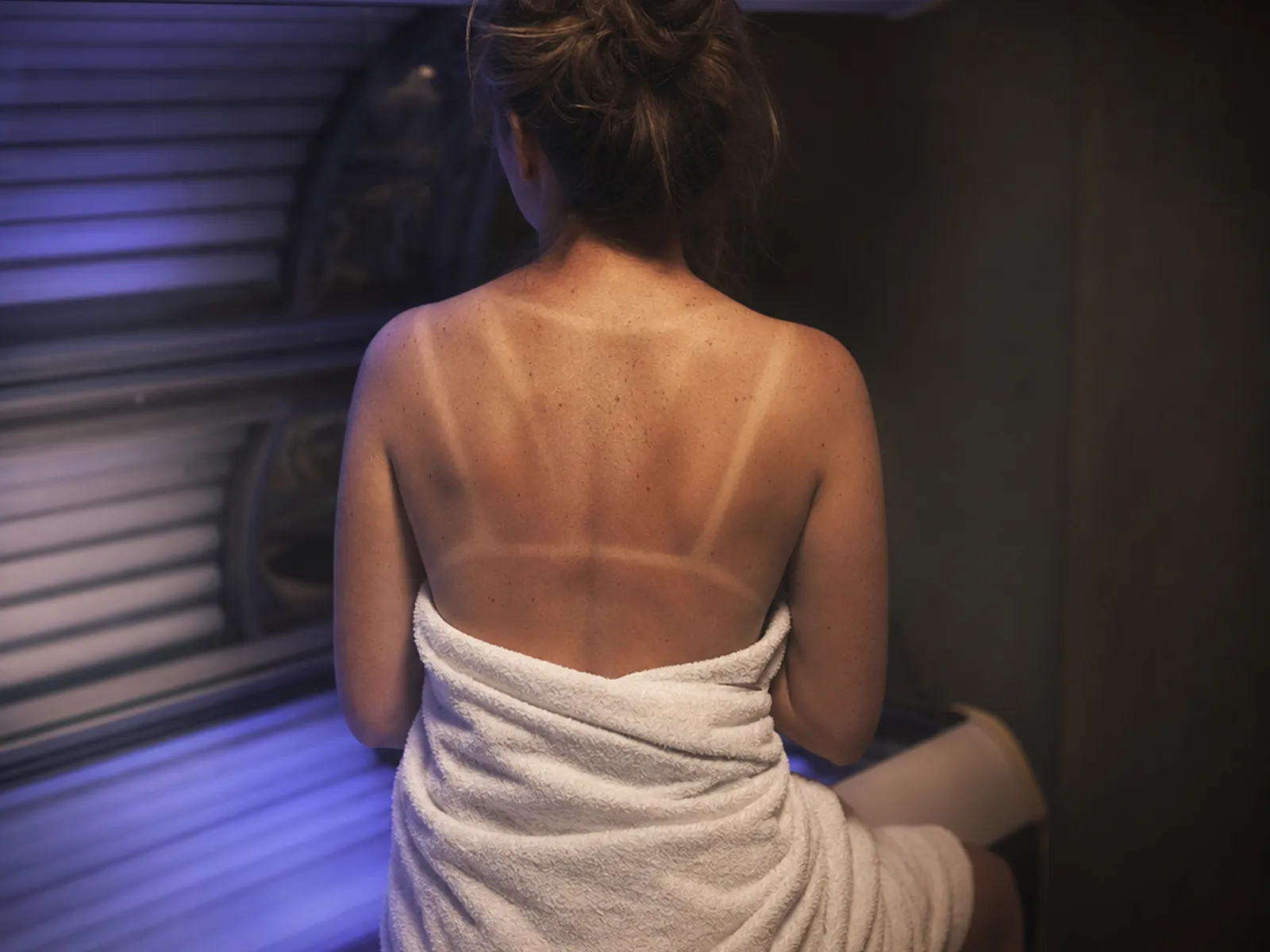
What a base tan is, and what it is not
A base tan is the color people try to build before a holiday, in the sun or in a tanning bed, in the hope that it will keep them from burning once they arrive. The color is real. It is melanin, the skin's own pigment, and the skin makes more of it after ultraviolet light reaches the cells. The measurements below apply whether the tan came from the sun or from a bed; the cancer figures further down are about tanning beds.
What starts the process matters. In laboratory studies, the signal that starts a tan comes from p53, a protein whose job is to sense DNA damage; mice without it do not tan. The Centers for Disease Control and Prevention puts it plainly: "A tan is the body's response to injury from UV rays, showing that damage has been done." In a study that built a tan in 12 adults with two weeks of small, below-sunburn doses, DNA damage in the skin built up during the doses that made the tan. A later study that compared tans made with different kinds of UV found that every kind damaged the skin's DNA.
So a base tan is not a sign that the skin has been toughened. It is a sign that the skin has already been exposed. Whether that color then does a useful job is a separate question, and it has been measured.
How much protection a tan gives: the measurements
The protection a tan gives can be measured by finding the dose of UV that just turns the skin red before and after tanning. The ratio of the two is the protection factor: a factor of 2 means the tanned skin needed about twice the dose to redden.
In the main study, 16 young adults had a patch of skin exposed Monday to Friday for two weeks to doses below the sunburn threshold. A week after the last dose, the tanned skin had a protection factor of 1.4 to 2.3, depending on skin type and dose. The authors called it "only moderate protection." In a second study by the same group, 12 adults tanned the same way had a protection factor of about 2, both for redness and for DNA damage. In an older study of 5 volunteers, a tan made with UVB gave about 3 times protection against burning, while a tan of the same shade made with UVA gave 1.4, which was not significantly different from no protection at all.
Agency statements agree with the measurements. The Food and Drug Administration states that "the extra melanin in tanned skin provides a Sun Protection Factor (SPF) of about 2 to 4; far below the minimum recommended SPF of 15." The CDC states that a base tan "only provides a sun protection factor (SPF) of about 3 or less, which does little to protect you from future UV exposure." Those are agency summaries rather than measurements, but they land in the same place as the studies: a small factor, far below the SPF 15 the FDA calls the minimum. One more thing to know about the measurements: they were made in small groups of young adults with light skin, not in people who have had a skin cancer treated.
Why a base tan does not stop a holiday sunburn
A protection factor of 2 means the tanned skin took about twice as much UV to turn red. If you would normally burn, you can still burn, just somewhat later. That is the whole arithmetic, and it is why the American Academy of Dermatology states: "If you have a base tan, you can still sunburn."
No trial has ever tested whether a course of tanning before a trip prevents burns on the trip. The International Agency for Research on Cancer, reviewing the studies that exist, wrote that "the evidence does not support a protective effect of the use of sunbeds against damage to the skin from subsequent sun exposure." There is also a mismatch of light. The AAD notes that the bulbs in tanning beds emit mostly UVA, and in the 1985 study a UVA tan gave no significant protection against burning. The two studies disagree on one point: in 1985 both kinds of tan cut one marker of DNA damage by about half, while the 2011 study found that a UVA tan gave essentially no protection against DNA damage. The studies that built a tan with repeated small doses, in 2002 and 2011, both found that building it damaged the skin's DNA.
None of this means the sun itself is simple. Being outdoors has real benefits, and our article Is There Such a Thing as a Safe Amount of Sun? goes through the evidence on both sides. The narrow point here is that building a tan on purpose, in advance, is an injury taken early, not protection banked.
What a tanning-bed session does
In 2009 the International Agency for Research on Cancer, the World Health Organization's cancer agency, classified UV-emitting tanning devices as "carcinogenic to humans," its highest category. That category describes how sure the agency is that something can cause cancer, not how large anyone's risk is. The size of the risk comes from pooled studies of people who did and did not use tanning beds.
In the largest pooled analysis, from 27 studies, people who had ever used a tanning bed had a melanoma risk 1.20 times that of people who never had. Among people who first used one before age 35 the ratio was 1.59, the figure the journal corrected a few months after publication. A separate review of 31 studies found a ratio of 1.34 for people who had attended more than 10 sessions. Its authors used study year as a rough stand-in for newer beds and found no clear difference between studies done before and after 2000, so nothing in it shows that newer beds are safer; they also rated the evidence they pooled "poor to mediocre." For the two common skin cancers, a review of 12 studies found that people who had ever tanned indoors had 1.67 times the risk of squamous cell carcinoma and 1.29 times the risk of basal cell carcinoma, and its authors estimated that, at the time, indoor tanning accounted for more than 170,000 cases of those cancers in the United States each year, a modelled figure rather than a count.
A ratio of 1.20 means 20 percent more melanomas among people who had used tanning beds than among people who never had. It is not a 20 percent chance of melanoma, and it is not your personal risk. Melanoma remains uncommon compared with the other two; what the numbers show is a consistent pattern across all three cancers. The largest ratios were for squamous cell carcinoma and for people who first used tanning beds before age 35.
Figure
Skin cancer in people who used tanning beds, compared with people who never did
Each row is a pooled estimate from one of three reviews of observational studies. A ratio of 1.20 means about 20 percent more cases among users than among non-users. It is not a personal risk.
Melanoma: ever used a tanning bed
Pooled relative risk, 27 studies (Boniol 2012)
Melanoma: first use before age 35
Pooled relative risk, corrected figure (Boniol 2012; see caption)
Melanoma: more than 10 sessions
Pooled odds ratio, from a review of 31 studies (Colantonio 2014)
Squamous cell carcinoma: ever used a tanning bed
Pooled relative risk, from a review of 12 non-melanoma studies (Wehner 2012)
Basal cell carcinoma: ever used a tanning bed
Same review (Wehner 2012)
Boniol and colleagues, BMJ, 2012 (the before-35 figure is the one the journal corrected in December 2012; an earlier review by the International Agency for Research on Cancer, 2007, put it at 1.75, interval 1.35 to 2.26); Colantonio and colleagues, Journal of the American Academy of Dermatology, 2014; Wehner and colleagues, BMJ, 2012. The reviews pool many of the same studies, so the rows are not five separate experiments. The Colantonio row is an odds ratio, a close cousin of the relative risk in the other rows, and its authors rated the evidence they pooled “poor to mediocre.” The 2007 review found no consistent dose pattern and no clear link to basal cell carcinoma; later reviews with more studies found a link with basal cell carcinoma (Wehner 2012) and higher melanoma risk with more sessions (Boniol 2012; Colantonio 2014). In the studies least prone to faulty recall, the cohort and population-based studies, Boniol’s estimate for ever use was similar: 1.25, interval 1.09 to 1.43. All of these are observational: no one was assigned to a tanning bed, and a trial that did so would not be ethical. What this means: people who used tanning beds were later diagnosed with all three common skin cancers more often than people who never did. The largest ratios were for squamous cell carcinoma and for people who first used tanning beds before age 35. Each ratio compares users with non-users for one cancer; the ratios do not rank the cancers by how common they are.
See the numbers as a table
| Outcome and exposure | Ratio | 95% confidence interval | Source |
|---|---|---|---|
| Melanoma, ever used | 1.20 (relative risk) | 1.08–1.34 | Boniol 2012, 27 studies |
| Melanoma, first use before age 35 | 1.59 (relative risk, corrected) | 1.36–1.85 | Boniol 2012, as corrected December 2012 |
| Melanoma, more than 10 sessions | 1.34 (odds ratio) | 1.05–1.71 | Colantonio 2014, review of 31 studies |
| Squamous cell carcinoma, ever used | 1.67 (relative risk) | 1.29–2.17 | Wehner 2012, 12 studies |
| Basal cell carcinoma, ever used | 1.29 (relative risk) | 1.08–1.53 | Wehner 2012, 12 studies |
"Once a week": what the studies can and cannot say
People search for "tanning bed once a week" because they want a number for that habit. There is none. No published study has measured once-a-week use as its own category, and no one can honestly turn the studies that exist into a weekly percentage.
What the studies do report is this. In a cohort of more than 100,000 women in Norway and Sweden, using a solarium once a month or more in their 30s carried a melanoma ratio of 1.49, and in their 40s, 1.61, compared with women who did not. The 31-study review above found a ratio of 1.34 for more than 10 sessions; that is a category the review used, not a safe limit below it. The 27-study review estimated a 1.8 percent rise in melanoma risk for each additional yearly session, with an uncertainty range that runs from 0 percent to 3.8 percent, so the low end of that estimate is no rise at all. Once a week is about 50 sessions a year. That is simple arithmetic, not a measured risk, but it places a weekly habit well above every "more than 10" and "monthly or more" group that the studies found at higher risk.
Two cautions belong here. All of these are observational studies: people chose to tan, and the studies then counted cancers. No one has ever been assigned to a tanning bed in a trial, and a trial that did so would not be ethical. And most of the clearest numbers come from people who started tanning young. The best evidence for later starters is the cohort of Norwegian and Swedish women above: using a tanning bed once a month or more in their 30s or 40s went with higher melanoma risk than never using one. Being above a group's cut-point says the risk was higher, not how much higher; the studies cannot say that for a weekly habit, and the 1.8 percent figure must not be multiplied by 50 to guess.
How long a base tan lasts
We looked for a measurement and did not find one. No published study has timed how many weeks a tan, or the small protection it gives, lasts. In the 16-adult study the protection was still there one week after the last dose, which is the only time point anyone measured.
What is known is more useful than a number. The color fades. The UV dose that made it does not, because it has already been delivered: the DNA damage measured in the 12-adult study accumulated during the tanning itself. The cancer studies link higher risk to more tanning-bed use, not to whether a person happens to be tan right now. A base tan that has faded by the end of the holiday has done its damage and given back none of it.
Spray tans and self-tanners
A sunless tanner gives the color without the UV. The FDA explains that the usual ingredient, dihydroxyacetone or DHA, "darkens the skin by reacting with amino acids in the skin's surface." No DNA is damaged to make that color, which is the whole advantage.
It is not a base tan, and it is not sunscreen. The FDA requires these products to carry the warning: "This product does not contain a sunscreen and does not protect against sunburn." In the one measurement, 10 volunteers treated twice with a strong 20 percent DHA cream had an SPF of 3.0 the next day, 2.0 at five days, and 1.7 at seven days. That is small, short-lived laboratory protection, not a sunscreen, and not enough to rely on. If you like the color, a self-tanner is the way to get it. Then protect the skin underneath exactly as you would without it.
What does work before a trip
The things that work are the ordinary ones, and they are the same ones our sun article lists: shade in the middle of the day, a hat, clothing that covers, and a broad-spectrum sunscreen on the skin you cannot cover, put on before you go out and again after swimming or sweating. The FDA calls SPF 15 the minimum; our sun article gives the level we suggest. For anyone tanning for vitamin D, the AAD notes that tanning-bed bulbs emit mostly UVA while the body needs UVB to make it, so a bed is not the way to get it; food, a supplement, or a blood test and a plan are, as our sun article explains. Sunscreen has trial evidence behind it. In a randomized trial in Queensland, Australia, adults who used sunscreen daily for about four years had fewer melanomas over the next ten years than adults who used it as they liked, and the drop was clearest for invasive melanoma; the numbers and the chart are in Is There Such a Thing as a Safe Amount of Sun?.
Two things to ask about before you go. Some medicines make skin burn more easily; ask your doctor or pharmacist about yours. And if you have had skin cancer, the doctor who follows you can tell you how often to have skin checks and what to watch for. If you have had skin surgery recently, sun on a healing wound or a new scar is a question for the surgeon who treated you, and surgeons' instructions differ. Follow the instructions from the surgeon who treated you. Everything on this page is general information: it can tell you what a tan does and does not do, and it cannot tell you what is right for your skin. Your own doctor can.
This page is general education and should not be construed as medical advice. The studies described here are averages across many people in other countries and do not predict your own risk; the right plan for your skin depends on your skin type, your history, and your health. Always consult your own doctor, and if you have had skin surgery, follow the instructions from the surgeon who treated you about sun on a healing wound. If you have a spot you are unsure about, or want a plain answer about protection, call us at (972) 378-0620.
Common questions
Answers reflect the general case — a physician who can see the wound always beats a page that cannot.
Selected peer-reviewed literature
The data behind the answer.
- Cui R, et al. Central role of p53 in the suntan response and pathologic hyperpigmentation. Cell. 2007;128(5):853–864. (opens in new tab)
- Sheehan JM, Potten CS, Young AR. Tanning in human skin types II and III offers modest photoprotection against erythema. Photochemistry and Photobiology. 1998;68(4):588–592. (opens in new tab)
- Sheehan JM, et al. Repeated ultraviolet exposure affords the same protection against DNA photodamage and erythema in human skin types II and IV but is associated with faster DNA repair in skin type IV. Journal of Investigative Dermatology. 2002;118(5):825–829. (opens in new tab)
- Gange RW, et al. Comparative protection efficiency of UVA- and UVB-induced tans against erythema and formation of endonuclease-sensitive sites in DNA by UVB in human skin. Journal of Investigative Dermatology. 1985;85(4):362–364. (opens in new tab)
- Miyamura Y, et al. The deceptive nature of UVA tanning versus the modest protective effects of UVB tanning on human skin. Pigment Cell & Melanoma Research. 2011;24(1):136–147. (opens in new tab)
- International Agency for Research on Cancer Working Group. The association of use of sunbeds with cutaneous malignant melanoma and other skin cancers: a systematic review. International Journal of Cancer. 2007;120(5):1116–1122. (opens in new tab)
- Boniol M, et al. Cutaneous melanoma attributable to sunbed use: systematic review and meta-analysis. BMJ. 2012;345:e4757 (correction: BMJ. 2012;345:e8503). (opens in new tab)
- Colantonio S, Bracken MB, Beecker J. The association of indoor tanning and melanoma in adults: systematic review and meta-analysis. Journal of the American Academy of Dermatology. 2014;70(5):847–857. (opens in new tab)
- Wehner MR, et al. Indoor tanning and non-melanoma skin cancer: systematic review and meta-analysis. BMJ. 2012;345:e5909. (opens in new tab)
- Veierød MB, et al. Sun and solarium exposure and melanoma risk: effects of age, pigmentary characteristics, and nevi. Cancer Epidemiology, Biomarkers & Prevention. 2010;19(1):111–120. (opens in new tab)
- Faurschou A, Wulf HC. Durability of the sun protection factor provided by dihydroxyacetone. Photodermatology, Photoimmunology & Photomedicine. 2004;20(5):239–242. (opens in new tab)
- U.S. Food and Drug Administration. The risks of tanning. (opens in new tab)
- U.S. Food and Drug Administration. Sunless tanners and bronzers. (opens in new tab)
- Centers for Disease Control and Prevention. A base tan is not a safe tan. 2014. (opens in new tab)
- American Academy of Dermatology. 10 surprising facts about indoor tanning. (opens in new tab)
- International Agency for Research on Cancer. Sunbeds and UV radiation. 29 July 2009. (opens in new tab)
If a spot has changed
We treat melanoma, basal cell carcinoma, and squamous cell carcinoma every day, and we examine skin for a living. If a tanning habit, past or present, is on your mind and something on your skin is new or changing, we would rather see it early.
Mohs Surgery for Melanoma
The most serious common skin cancer — treated here with same-day, margin-controlled Mohs surgery for appropriate cases.
Basal Cell Carcinoma
The most common skin cancer — slow to spread, but destructive locally. Mohs offers the most precise removal.
Squamous Cell Carcinoma
The second most common skin cancer — treated promptly because it can spread. High-risk tumors get immunostained margin control.
Request a Consultation
A question about a spot that worries you?
Call us, or send an appointment request — requests receive a call back within one business day.
(972) 378-06206100 Windhaven Parkway, Plano, TX 75093 · Mon-Thurs: 7:30-4 | Fri: 10-2