Can You Put Neosporin on Stitches?
Medically reviewed by Gunjan Modi, MD, FAAD, FACMS, board-certified dermatologist and fellowship-trained Mohs surgeon · Updated September 20, 2026
The short answer
Ask the surgeon who placed your stitches before you put anything on them. Not all stitches and not all sutured wounds are the same, and the right care depends on how yours was closed. In general, ointment on a sutured wound is good for healing and for how the scar looks, and in our office we do recommend ointment. We do not recommend Neosporin: its neomycin is a very potent contact allergen, especially after surgery. Our standard recommendation is plain Vaseline, 100% petroleum jelly with no fragrance. This page is general education, not medical advice.
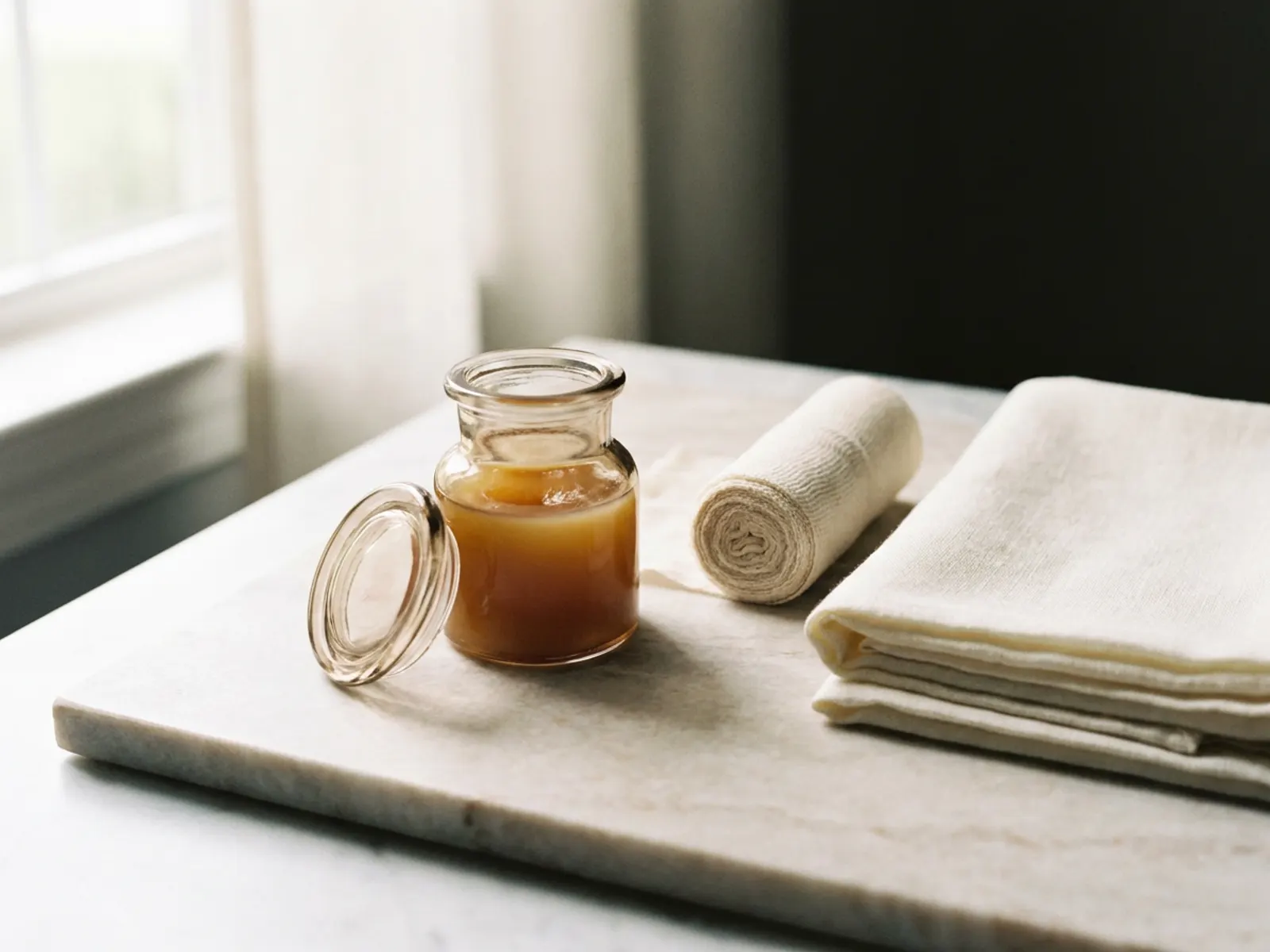
First, ask the person who put the stitches in
Stitches are not all alike. Surgeons use different suturing techniques and different types of suture. Some stitches sit on top of the skin, where you can see them. Some are placed only under the skin. Not all sutured wounds are the same, and the care that suits one may not suit another.
So the first step is always the same: follow the instructions from your own doctor, the surgeon or clinician who placed your stitches. They know how your wound was closed and what it needs. Nothing on this page should be taken as medical advice for your wound. What follows is how we approach ointment for stitches in our own office, and the research behind it.
If you have Steri-Strips, ask before using ointment
Some sutured wounds have Steri-Strips on top, the thin adhesive strips placed across the incision. Whether a surgeon uses them can depend on whether there are stitches on top of the skin or only stitches under the skin.
Ointment on Steri-Strips can make them fall off sooner. Depending on the type of wound, that may not be what your surgeon wants. If your wound has strips over it, ask your surgeon before applying any ointment.
Why ointment helps a sutured wound
Ointment on a sutured wound is good for wound healing and for the aesthetic outcome, meaning how the scar looks in the end. In our office, we do recommend ointment.
The reason is moisture. A published review of moist wound healing concluded that a moist wound environment brings faster and better-quality healing, less pain, and less scarring. In a prospective study of stitched facial wounds, scars looked better when a moisture-retaining ointment was applied during healing than when no topical treatment was used. That study used a different product from the ones discussed on this page, so it supports the principle, not a brand.
The evidence does not all point one way. A randomized trial followed 1,801 stitched skin-surgery wounds that were all kept under an occlusive dressing, a sealed bandage that holds moisture in. Infection rates, complications, and how patients felt about their wounds six to nine months later were no different whether or not ointment was applied under that dressing. How to keep your particular wound from drying out is a decision for your surgeon.
Why we do not recommend Neosporin on sutures
Neosporin contains neomycin, a very potent contact allergen, especially after surgery. An allergic reaction to it produces a red, itchy rash around the wound that is easily mistaken for an infection. Our article Should You Put Neosporin on a Wound? covers this in detail.
A published review of ointments used after surgery found neomycin to be the most common cause of allergic contact dermatitis among the topical antibiotics, both in people tested for skin allergies and in patients after surgery. Its authors concluded that neomycin should be avoided on closed wounds after surgery and that white petrolatum is an effective alternative. In a survey of members of the American College of Mohs Surgery, neomycin was the ingredient surgeons most often asked patients not to use, named by about 93 percent of those who responded.
An antibiotic ointment has also not been shown to prevent infection in clean stitched wounds any better than plain petrolatum. In a randomized trial of 922 dermatologic surgery patients published in JAMA, infection rates with white petrolatum and with bacitracin ointment were low and statistically no different. A later analysis that pooled four trials of skin-surgery wounds reached the same conclusion.
The best ointment for stitches: what we recommend in our office
There is no single best ointment for every sutured wound, and your surgeon's instructions come first. In the same survey of Mohs surgeons, petroleum jelly was the ointment most often recommended for wound care at home, by about 69 percent of respondents, followed by Aquaphor at about 38 percent. These are the options we discuss with our own patients:
- Plain Vaseline: 100% petroleum jelly, with no fragrance. This is our standard recommendation.
- Aquaphor: a good option. It contains lanolin, which can be another contact allergen.
- Bacitracin: an option some surgeons use. It contains no neomycin, but it can cause contact allergy too.
- Mupirocin: a prescription antibiotic ointment that is frequently used on sutured wounds, and the one we most frequently use for our own patients.
A closer look at lanolin, bacitracin, and mupirocin
Lanolin, found in Aquaphor, was named Allergen of the Year for 2023 by the American Contact Dermatitis Society. Among 43,691 people patch tested by the North American Contact Dermatitis Group between 2001 and 2018, 3.3 percent reacted to it. Those were people already being evaluated for a skin allergy. Lanolin allergy is thought to be rare in people with healthy skin, which is why Aquaphor remains a good option for most patients.
Bacitracin is one of the three antibiotics in Neosporin, and it is also sold on its own. It can cause contact allergy in some people too, as our Neosporin article explains, though the review of post-surgical ointments found it a less frequent cause than neomycin.
Mupirocin requires a prescription. The same review did not find mupirocin to be a significant cause of contact allergy. Whether a prescription ointment is right for your wound is a decision for the surgeon who is caring for it.
Should you put a bandage over the ointment?
Follow your surgeon's dressing instructions first. In general, the routine dermatologists recommend for a healing surgical wound is a thin layer of ointment covered with a nonstick bandage, changed daily or when it gets wet. A wound kept moist and covered heals more comfortably and with less crusting than one left open to dry out and scab.
Suture care: when to call your surgeon
Most sutured wounds heal without trouble. Call the surgeon who placed your stitches if you notice any of the following:
- Redness that spreads beyond the edge of the wound
- Pain that increases after the first two to three days instead of easing
- Pus or cloudy drainage
- Fever
- A red, itchy rash where the ointment was applied. This can be an allergy to the ointment, not an infection, and it needs a proper look to tell the two apart
This page is general education and should not be construed as medical advice. Not all stitches and not all sutured wounds are the same: there are different suturing techniques and different types of suture. Always consult your own doctor, the surgeon or clinician who placed your stitches, and follow their instructions before applying anything to the wound. If we placed your stitches and you have a question about a healing wound, call us at (972) 378-0620.
Common questions
Answers reflect the general case — a physician who can see the wound always beats a page that cannot.
Selected peer-reviewed literature
The data behind the answer.
- Smack DP, et al. Infection and allergy incidence in ambulatory surgery patients using white petrolatum vs bacitracin ointment: a randomized controlled trial. JAMA. 1996;276(12):972–977.
- Sheth VM, Weitzul S. Postoperative topical antimicrobial use. Dermatitis. 2008;19(4):181–189.
- Saco M, Howe N, Nathoo R, Cherpelis B. Topical antibiotic prophylaxis for prevention of surgical wound infections from dermatologic procedures: a systematic review and meta-analysis. Journal of Dermatological Treatment. 2015;26(2):151–158.
- Dixon AJ, Dixon MP, Dixon JB. Randomized clinical trial of the effect of applying ointment to surgical wounds before occlusive dressing. British Journal of Surgery. 2006;93(8):937–943.
- Nijhawan RI, Smith LA, Mariwalla K. Mohs surgeons' use of topical emollients in postoperative wound care. Dermatologic Surgery. 2013;39(8):1260–1263.
- Nuutila K, Eriksson E. Moist wound healing with commonly available dressings. Advances in Wound Care. 2021;10(12):685–698.
- Atiyeh BS, et al. Improving scar quality: a prospective clinical study. Aesthetic Plastic Surgery. 2002;26(6):470–476.
- Silverberg JI, et al. Lanolin allergic reactions: North American Contact Dermatitis Group experience, 2001 to 2018. Dermatitis. 2022;33(3):193–199.
- Johnson H, Norman T, Adler BL, Yu J. Lanolin: the 2023 American Contact Dermatitis Society Allergen of the Year. Cutis. 2023;112(2):78–81.
- American Contact Dermatitis Society Allergens of the Year 2000 to 2020 (neomycin, 2010; bacitracin, 2003).
If a spot will not heal
A wound that never quite closes is one of the ways skin cancer first announces itself. Diagnosing and removing skin cancer is what this practice does all day, every day.
Basal Cell Carcinoma
The most common skin cancer — slow to spread, but destructive locally. Mohs offers the most precise removal.
Squamous Cell Carcinoma
The second most common skin cancer — treated promptly because it can spread. High-risk tumors get immunostained margin control.
Mohs Surgery for Melanoma
The most serious common skin cancer — treated here with same-day, margin-controlled Mohs surgery for appropriate cases.
Request a Consultation
A question about a spot that worries you?
Call us, or send an appointment request — requests receive a call back within one business day.
(972) 378-06206100 Windhaven Parkway, Plano, TX 75093 · Mon-Thurs: 7:30-4 | Fri: 10-2