Can Stitches Get Wet? When Can I Shower or Swim?
Medically reviewed by Gunjan Modi, MD, FAAD, FACMS, board-certified dermatologist and fellowship-trained Mohs surgeon · Updated October 2, 2026
The short answer
A quick shower and a long soak are different questions. In three randomized trials, stitched skin wounds that got wet between 6 and 48 hours after surgery were not infected more often than wounds kept dry. The trials were not large enough to rule out a small difference. They looked at early washing and showering. They do not show when it is safe to soak. We found no study of swimming, hot tubs, lakes, or the ocean with stitches. Public health pages, such as Australia's healthdirect, advise waiting until the stitches are out and the wound has sealed, and many surgeons give similar advice. Instructions also depend on how the wound was closed, where it is, and what dressing covers it. Follow the written instructions from the surgeon who treated you. They know your wound. This page does not.
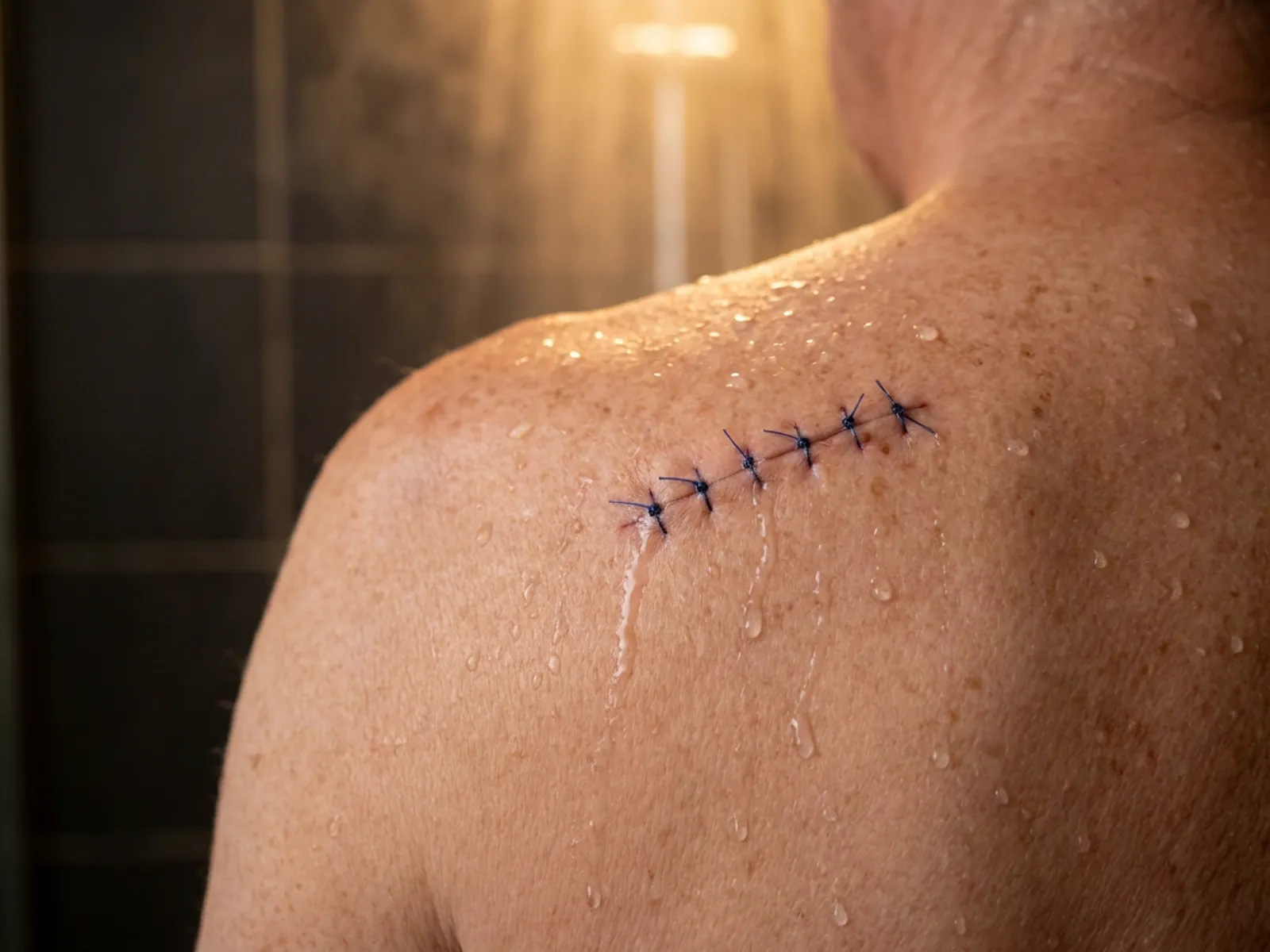
Shower, soak, or splash: three different questions
People use "getting stitches wet" to mean three different things. A shower means clean water running over the wound for a few minutes, then patting it dry. A soak means the wound sits under water: a bath, a hot tub, a swimming pool, a lake, or the ocean. A splash is an accident, such as a wet bandage after washing your hands or getting caught in the rain.
The research answers the first question, and only partly. Randomized trials have compared letting a stitched wound get wet early with keeping it dry. No trial has set out to test soaking a stitched wound, and no one has studied accidental splashes. This page explains what the trials found, where they stop, and why your surgeon's written instructions may differ from what you read here. Those instructions come first.
What happened when trials let stitched wounds get wet early
The largest trial was run in general practices in Queensland, Australia, and published in the BMJ in 2006. It randomized 857 people having a minor skin lesion cut out and stitched. One group took the dressing off after about 12 hours and let the wound get wet during normal bathing; the other kept it dry and covered for 48 hours. Infection followed 8.4 percent of the wet group and 8.9 percent of the dry group. The trial was designed to show that early wetting was not worse by more than a set margin, and it met that test. Because the wet group also lost its dressing, the trial did not test water on its own. And those infection rates are far higher than skin-cancer surgery centers report, which says something about the setting, not about getting wet.
The trial closest to Mohs surgery was published in the Journal of the American Academy of Dermatology in 2024. At one academic center, 437 people having skin surgery were randomized to get the wound wet 6 hours after surgery or to keep it dry and covered for 48 hours. Culture-proven infection occurred in 1.8 percent of the early-wet group and 1.4 percent of the dry group, a difference that could easily be chance. The study found no difference in bleeding or bruising, and scar scores were similar. A third trial, from Taiwan, compared showering with staying dry after thyroid, lung, hernia, face, and limb surgery, with both groups waiting 48 hours: 4 of 220 showered patients and 6 of 220 kept-dry patients developed a surface infection.
A 2015 Cochrane review found only the Queensland trial, rated it at high risk of bias, and concluded the evidence was inconclusive: the range around its result (a risk ratio of 0.96, with a 95 percent confidence interval from 0.62 to 1.48) could not rule out either more or fewer infections with early wetting. A 2020 meta-analysis pooled seven randomized trials of early showering, 1,881 patients across many kinds of surgery, and found no difference in infection. A 2013 review of nine studies and 2,150 patients reached the same conclusion. These reviews re-analyze largely the same trials, so they are one body of evidence, not several. The idea is not new: in 1988 a plastic surgeon reported 100 patients told to wash their stitched wounds with soap and water twice a day from the morning after surgery, with no infections, though that series had no comparison group.
Figure
Did wounds that got wet get infected more often? Three randomized trials
Each panel is one trial, headed by when its patients were allowed to get the wound wet. The solid bronze bar is the group allowed to get the wound wet; the pale bar is the group told to keep it dry. Bar length is the share of patients whose wound became infected, on a 0 to 10% scale.
Data: Heal C, et al. Can sutures get wet? BMJ. 2006;332:1053–1056 (the 12-hour timing, the 8.5% vs 8.8% figures and the risk ratio are from the Cochrane review of that trial: Toon CD, et al. Cochrane Database of Systematic Reviews. 2015;(7):CD010075); Samaan C, et al. Journal of the American Academy of Dermatology. 2024;91:896–903; Hsieh PY, et al. Annals of Surgery. 2016;263:931–936. In none of the three trials was the difference statistically significant; for the Queensland trial that is the Cochrane review’s finding, while the trial itself reported that early wetting was not worse by more than a set margin. Compare the two bars within one panel only: the trials studied different operations and counted infection differently. The Queensland trial was general-practice minor surgery with a high background infection rate, far above what skin-cancer surgery centers report, and its wet group also had the dressing removed, so water was not tested on its own; the 2024 trial counted only culture-proven infections after skin surgery; in the Taiwan trial both groups waited 48 hours, so it compares showering with staying dry rather than early with late. None of the trials was large enough to rule out a small difference. For the Queensland trial alone, the Cochrane review judged the evidence inconclusive: its risk ratio of 0.96 came with a 95% confidence interval of 0.62 to 1.48, a range that includes both fewer and more infections with early wetting. None of the three was designed to test skin grafts, open wounds, or swimming. What this means: in these trials, letting a stitched wound get wet early did not show up as extra infections. That is not evidence about soaking, and your own surgeon’s instructions come first. This figure is our own drawing of the published numbers.
See the numbers as a table
| Trial | When the wet group got wet | Setting | Wet group | Dry group | Result as published |
|---|---|---|---|---|---|
| Heal 2006 | wet from about 12 hours, dressing off | minor skin excisions in general practice, Queensland; 857 patients | Allowed to get wet: 8.4% | Kept dry and covered 48 hours: 8.9% | Not worse by more than the trial's set margin (P < 0.05). Cochrane re-analysis of this trial: 8.5% vs 8.8%, risk ratio 0.96, 95% CI 0.62 to 1.48, no statistically significant difference. |
| Samaan 2024 | water exposure at 6 hours | skin surgery at one academic center; 437 patients | Allowed to get wet: 1.8% | Kept dry and covered 48 hours: 1.4% | No significant difference (P > .99). Infection was culture-proven. No confidence interval published. |
| Hsieh 2016 | showered from 48 hours (both groups waited 48 hours) | thyroid, lung, hernia, face and limb surgery, Taiwan; 440 patients analyzed | Allowed to shower: 1.8% (4 of 220) | Kept dry: 2.7% (6 of 220) | No significant difference (P = 0.751). Compares showering with staying dry from 48 hours, not early with late wetting. No confidence interval published. |
Why the answer is still not a simple yes
Not worse by more than a margin is not the same as identical. The two skin-surgery trials counted only a handful of infections in each group, so they could not detect a small difference. The Cochrane authors also pointed out a possible downside of early washing: irritating or macerating the wound, meaning the skin goes white and soft from too much moisture.
The trials also studied mostly simple stitched closures. Skin grafts, which are often held in place by a tie-over dressing called a bolster, wounds left open to heal on their own, wounds with a drain, and many flap repairs were not the test population. A surgeon who asks you to keep one of those wounds dry for longer is not ignoring the research. The research does not cover that wound.
Soaking: baths, hot tubs, pools, lakes, and the ocean
A PubMed search for this article (October 2026) found no study of swimming, hot tubs, lakes, or the ocean with stitches, and no trial designed to test soaking a stitched wound. The advice on public health pages reflects that gap. Australia's healthdirect, for example, says that after 48 hours you can wet the area gently and briefly, for example in a sink or shower, and that you should not soak in a bath or swim until the stitches are removed or have dissolved. Many surgeons give similar advice. The literature is silent on swimming, so the answer for your wound comes from your surgeon, not from a study.
The reasons are practical rather than proven. Soaking keeps the wound under water for a long time and softens the skin around the stitches. Hot tubs and whirlpools are a known home for the bacterium Pseudomonas aeruginosa, which has caused outbreaks of folliculitis (infected hair follicles) and ear infections traced to hot tubs, pools, and water slides. That is environmental microbiology, not a wound study: the same bacterium also lives in faucets and showerheads, and no study has measured what it does to a stitched wound. It explains why surgeons treat a hot tub differently from a shower. It does not set a safe date.
Stitches coming out is not an automatic green light either. Some sutures are buried under the skin and dissolve slowly, and a wound whose surface has sealed is still weak for weeks. Ask the surgeon who treated you when your wound is ready to go under water, and whether a pool, a lake, and the ocean count the same.
Why instructions vary: how and where the wound was closed
Infection after skin surgery is uncommon, but it is not evenly spread. In a prospective study of 5,091 skin lesions treated without preventive antibiotics, infection followed 0.54 percent of simple excisions, 2.94 percent of flap repairs, and 8.70 percent of skin grafts. By location, 0.81 percent of face wounds became infected, compared with 6.92 percent of wounds below the knee. A 2022 meta-analysis of 33,086 skin-surgery wounds found the trunk had the lowest infection rate and the lips had a significantly higher one, with the lower legs, and probably the ears and hands, also running higher. In a study of 1,000 Mohs surgery patients, infection followed 0.91 percent of the 1,204 tumors treated, about 1 in 100.
These numbers show where infection is more common. They do not show that water causes it, and no trial tested wetting a leg wound or a graft separately. They do explain why instructions differ. A surgeon closing a lower-leg wound, placing a graft with a bolster, or protecting a flap with a pressure dressing may ask for a longer dry period than a surgeon closing a simple line on the cheek. Dressings matter too: a bolster must stay dry, adhesive strips lift when wet, and a bulky pressure dressing that gets soaked needs changing. Two surgeons can give different instructions for similar wounds and both be reasonable. Yours were written for your wound.
After 24 hours, 4 days, a week: what a day count can and cannot tell you
The trials wet wounds at 6 hours, at about 12 hours, and at 48 hours. The 48-hour figure that appears on many instruction sheets and public guidance pages matches the period over which the skin surface usually closes: a Cochrane review of surgical dressings describes a dressing's job as protecting the wound until the continuity of the skin is restored, within about 48 hours. That is background biology, not a trial result, and a sealed surface is not a strong wound. The stitches are still doing the work.
No trial compared day 4 with day 7, or day 7 with day 14. If your surgeon told you a brief shower was fine after a set number of days, that is the answer for your wound. By four days or a week, the question most people are really asking is about soaking, and that is covered above: wait for the surgeon's go-ahead.
If your surgeon says a shower is fine: what the trials and guidance pages describe
This is a description of what the trials and public guidance pages say, not instructions for your wound. In the trials, the wound was allowed to get wet; it was not scrubbed. Healthdirect describes wetting the area gently and briefly and patting the stitches dry right away. The American Academy of Dermatology's wound-care page describes gently washing with mild soap and water, then keeping the wound moist with petroleum jelly. Whether to use an ointment, and which one, depends on your surgeon; our article Can You Put Neosporin on Stitches? explains why plain petrolatum is usually preferred.
A dressing that gets wet is not meant to stay wet. Guidance pages describe replacing it with a clean, dry one. If the wet dressing is a bolster, a pressure dressing, or something you were told not to touch, that is a call to the office rather than a do-it-yourself change.
When to call the surgeon who treated you
Most stitched wounds heal without trouble. Call the surgeon who treated you if you notice any of the following:
- Redness that spreads beyond the edge of the wound
- Pain that gets worse instead of easing
- Pus or cloudy drainage
- Fever
- A wound that opens up
- A bolster or pressure dressing that has been soaked through or has come loose
This page is general education and should not be construed as medical advice. Not all stitches and not all sutured wounds are the same: there are different closures, different sites, and different dressings, and the research described here did not test them all. Always consult your own doctor, the surgeon or clinician who placed your stitches, and follow their instructions on showering, bathing, and swimming before anything you read here. If we placed your stitches and you have a question about a healing wound, call us at (972) 378-0620.
Common questions
Answers reflect the general case — a physician who can see the wound always beats a page that cannot.
Selected peer-reviewed literature
The data behind the answer.
- Heal C, Buettner P, Raasch B, et al. Can sutures get wet? Prospective randomised controlled trial of wound management in general practice. BMJ. 2006;332(7549):1053–1056. (opens in new tab)
- Toon CD, Sinha S, Davidson BR, Gurusamy KS. Early versus delayed post-operative bathing or showering to prevent wound complications. Cochrane Database of Systematic Reviews. 2015;(7):CD010075. (opens in new tab)
- Samaan C, Kim Y, Zhou S, Kirby JS, Cartee TV. Early postoperative water exposure does not increase complications in cutaneous surgeries: a randomized, investigator-blinded, controlled trial. Journal of the American Academy of Dermatology. 2024;91(5):896–903. (opens in new tab)
- Hsieh PY, Chen KY, Chen HY, et al. Postoperative showering for clean and clean-contaminated wounds: a prospective, randomized controlled trial. Annals of Surgery. 2016;263(5):931–936. (opens in new tab)
- Copeland-Halperin LR, Reategui Via Y Rada ML, Levy J, Shank N, Funderburk CD, Shin JH. Does the timing of postoperative showering impact infection rates? A systematic review and meta-analysis. Journal of Plastic, Reconstructive & Aesthetic Surgery. 2020;73(7):1306–1311. (opens in new tab)
- Dayton P, Feilmeier M, Sedberry S. Does postoperative showering or bathing of a surgical site increase the incidence of infection? A systematic review of the literature. Journal of Foot and Ankle Surgery. 2013;52(5):612–614. (opens in new tab)
- Noe JM, Keller M. Can stitches get wet? Plastic and Reconstructive Surgery. 1988;81(1):82–84. (opens in new tab)
- Toon CD, Lusuku C, Ramamoorthy R, Davidson BR, Gurusamy KS. Early versus delayed dressing removal after primary closure of clean and clean-contaminated surgical wounds. Cochrane Database of Systematic Reviews. 2015;(9):CD010259. (opens in new tab)
- Dixon AJ, Dixon MP, Askew DA, Wilkinson D. Prospective study of wound infections in dermatologic surgery in the absence of prophylactic antibiotics. Dermatologic Surgery. 2006;32(6):819–826. (opens in new tab)
- Schlager JG, Ruiz San Jose V, Patzer K, French LE, Kendziora B, Hartmann D. Are specific body sites prone for wound infection after skin surgery? A systematic review and meta-analysis. Dermatologic Surgery. 2022;48(4):406–410. (opens in new tab)
- Rogers HD, Desciak EB, Marcus RP, Wang S, MacKay-Wiggan J, Eliezri YD. Prospective study of wound infections in Mohs micrographic surgery using clean surgical technique in the absence of prophylactic antibiotics. Journal of the American Academy of Dermatology. 2010;63(5):842–851. (opens in new tab)
- Mena KD, Gerba CP. Risk assessment of Pseudomonas aeruginosa in water. Reviews of Environmental Contamination and Toxicology. 2009;201:71–115. (opens in new tab)
- healthdirect (Australian Government). Caring for stitches (sutures). Last reviewed July 2025. (opens in new tab)
- American Academy of Dermatology. Minimize a scar: proper wound care tips from dermatologists. (opens in new tab)
If a spot will not heal
A wound that never quite closes is one of the ways skin cancer first announces itself. Diagnosing and removing skin cancer is what this practice does all day, every day.
Basal Cell Carcinoma
The most common skin cancer — slow to spread, but destructive locally. Mohs offers the most precise removal.
Squamous Cell Carcinoma
The second most common skin cancer — treated promptly because it can spread. High-risk tumors get immunostained margin control.
Mohs Surgery for Melanoma
The most serious common skin cancer — treated here with same-day, margin-controlled Mohs surgery for appropriate cases.
Request a Consultation
A question about a spot that worries you?
Call us, or send an appointment request — requests receive a call back within one business day.
(972) 378-06206100 Windhaven Parkway, Plano, TX 75093 · Mon-Thurs: 7:30-4 | Fri: 10-2