Should You Put Hydrogen Peroxide or Rubbing Alcohol on a Cut?
Medically reviewed by Gunjan Modi, MD, FAAD, FACMS, board-certified dermatologist and fellowship-trained Mohs surgeon · Updated October 2, 2026
The short answer
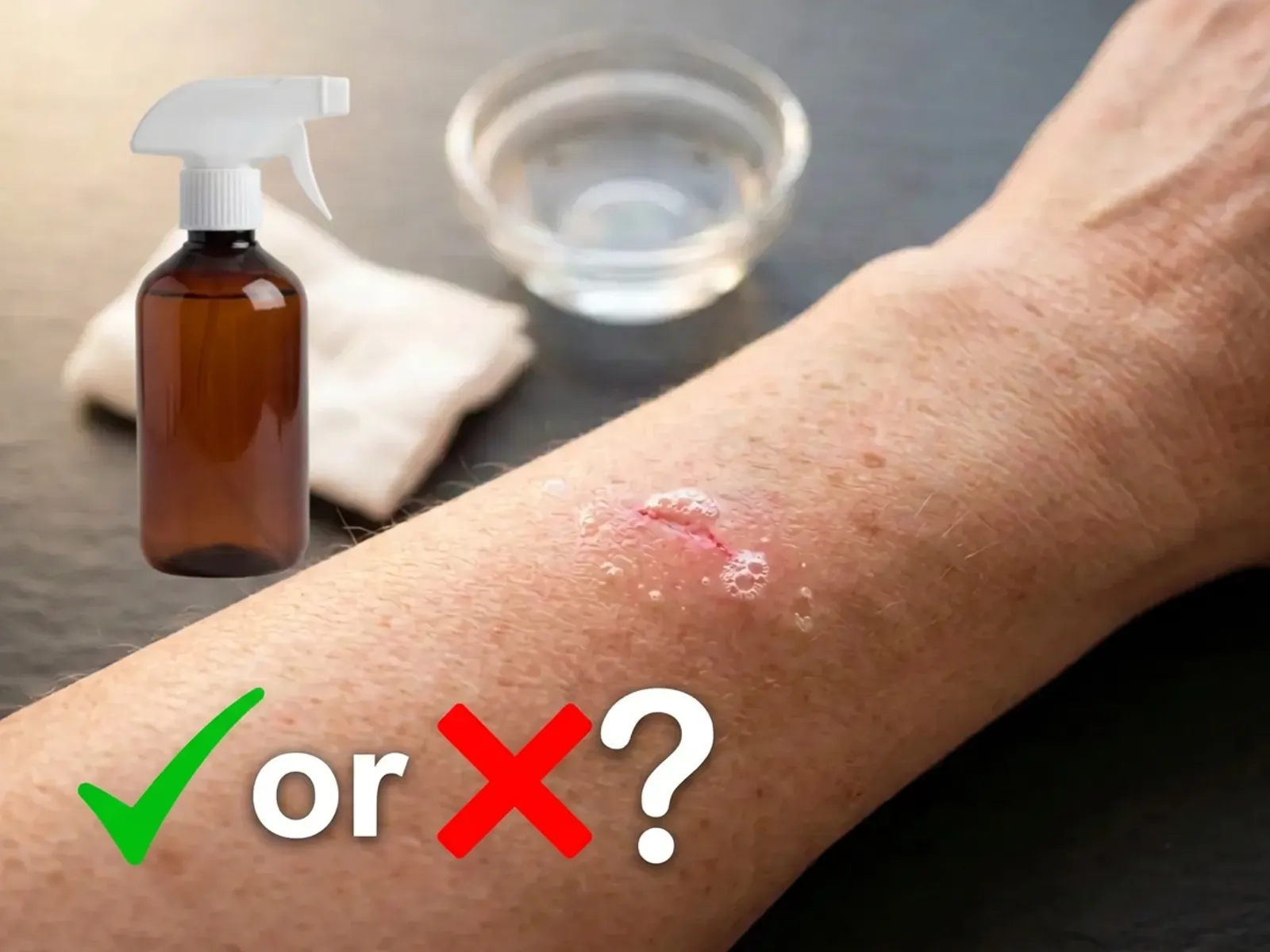
For an everyday cut, no. Neither one is needed to clean it. In lab tests, hydrogen peroxide harmed the skin cells that help a wound heal. In two randomized trials, after appendix surgery and around wrist pins, it did not come out ahead. The fizz is oxygen gas: an enzyme in your blood and tissue splits peroxide into water and oxygen. Fizzing does not prove germs are being killed. We found no trial of rubbing alcohol on a healing cut, so the advice to skip it rests on the same cell-harm concern and on expert guidance, not a trial. For an everyday cut, wash with mild soap and running water, keep it moist with plain petroleum jelly, and cover it with a nonstick bandage. If you have a surgical wound, follow the instructions from the surgeon who treated you.
What peroxide does to skin cells
Household hydrogen peroxide is a 3 percent solution. It is an oxidizing agent, and that is how it kills germs. The problem is that it does the same thing to the cells your body uses to repair a wound. In a 1985 lab study, 3 percent hydrogen peroxide at full strength killed 100 percent of the human fibroblasts it was placed on. Fibroblasts are the cells that rebuild the deeper layer of skin. When the researchers diluted the peroxide step by step, it kept harming fibroblasts more than it harmed the bacteria, across the dilutions tested.
A 2005 lab study measured 17 wound cleansers and 3 liquid soaps on cultured human skin cells and gave each one a toxicity index from 0 to 100,000. Hydrogen peroxide scored the maximum, 100,000, on keratinocytes, the outer-skin cells that resurface a wound. Only the products at the two ends of the scale are reported, and the index is a cell-culture measure, not a measure of harm in a living wound.
These are lab-dish results, and they need that label. Cells in a dish have no blood, no tissue fluid, and no rinse to wash the peroxide away. The same 1985 research group concluded that 3 percent hydrogen peroxide was unsuitable for use in wound care, yet in their animal experiment peroxide was the one cell-toxic antiseptic that did not slow wound healing. Lab toxicity does not translate one-for-one into harm in a living wound. It is a reason for caution, not proof of damage.
Why it fizzes and turns the skin white
Blood and living tissue contain an enzyme called catalase. When hydrogen peroxide touches it, catalase splits the peroxide into water and oxygen gas, fast. The fizz you see is that oxygen escaping. A toxicology review of hydrogen peroxide describes this rapid breakdown by catalase into oxygen and water; it is the reason the body clears peroxide so quickly.
The white color is thought to come from the same reaction: oxygen forming in the top layers of the skin faster than it can escape, so tiny bubbles make the tissue look pale. None of the studies on this page measured the whitening directly, so that is an explanation, not a tested finding. It fades on its own.
Fizzing does not prove germs are being killed. It happens because your own cells and blood carry catalase, whether or not the cut is infected. Peroxide can kill bacteria, but the bubbling tells you nothing about that. It only tells you the enzyme is there.
Does it prevent infection or speed healing?
Two randomized trials have tested hydrogen peroxide on wounds in people. In a 1981 trial, 217 patients having an appendix removed were assigned to topical hydrogen peroxide or no peroxide. There was no statistically significant difference in wound infection rates between the groups. In a 2006 trial, 118 patients with 120 broken wrists held by external pins were assigned to daily pin-site care with a half-and-half mix of saline and hydrogen peroxide, to chlorhexidine discs, or to dry dressings alone. Pin-site complications were not reduced by either treatment, and the authors recommended dry, sterile dressings only.
Neither trial is a clean skin-surgery wound or an everyday cut, and no difference found is not the same as proven useless. But we could find no trial that has tested household peroxide against soap and water on a clean cut or a healing skin-surgery wound. These are the trials there are, and nothing in them shows a benefit.
On healing speed, the evidence is lab and animal, and it is mixed. In a small pig study (four animals), 3 percent peroxide significantly reduced the formation of new dermis and was the only agent tested that did not significantly increase fibroblast growth, though the wounds resurfaced at the same rate as the others. A 1975 study of surgical donor sites found that peroxide seemed to loosen the scab sooner and shorten healing time, but blisters and ulceration appeared when it was applied after the scab had separated and new skin was visible. The authors advised avoiding it once the crust is gone.
What about rubbing alcohol?
We looked for a study of rubbing alcohol on a healing cut and did not find one. So the advice here rests on two things, not on a trial. The first is the same principle as peroxide: in the lab tests above, antiseptics strong enough to kill germs also harmed skin cells. All four antiseptics in the 1985 study killed 100 percent of fibroblasts at full strength. Alcohol was not among the products tested, so applying that finding to alcohol is an inference. The second is guidance: the American Academy of Dermatology's patient pages name mild soap and water for cleaning a cut, not alcohol, and the CDC's 2017 guideline on surgical infection places alcohol-based antiseptics on intact skin before an incision, not in the wound afterward.
Rubbing alcohol also stings on an open cut, which is reason enough for most people. Keep both alcohol and peroxide away from the eyes; the toxicology review notes that even 3 percent peroxide stings and irritates the eye. If the surgeon who treated you gave you different instructions for a specific reason, follow them.
Where antiseptics do belong
Antiseptics are not bad. They have a real job, on the right surface. The CDC's 2017 guideline for preventing infection after surgery says skin preparation in the operating room should use an alcohol-based agent, with exceptions. That is intact skin, wiped before the first cut. Cleaning the skin before surgery and cleaning an open wound afterward are different jobs.
Antiseptics are also used on some infected or high-risk wounds, chosen by a clinician. A 2018 expert consensus on wound antisepsis recommends specific agents for infected, contaminated, and chronic wounds, and in the same document classes hydrogen peroxide alone as obsolete. The point is who chooses and why. A wound-care specialist selecting an antiseptic for a stalled, infected ulcer is a different situation from a bottle of peroxide poured on a kitchen cut.
Surgeons also differ on brief, directed uses. The 1975 donor-site study found that peroxide seemed to loosen scabs sooner before the crust separated, and some surgeons use a diluted solution for a short time to loosen dried blood or crust around a healing wound. The studies on this page do not settle whether that brief use helps or hurts. It is a different question from daily home use, and the answer belongs to the surgeon who treated you.
What to use instead
First, if you had skin surgery, your wound is not an everyday cut. Grafts, flaps, wounds left to heal on their own, and wounds under a pressure dressing or bolster each have their own care, and your dressing may need to stay on until the surgeon says. Follow the instructions you were given, and ask before you change anything. The rest of this section is for an everyday cut.
The American Academy of Dermatology's patient pages give a simple routine. Wash the cut gently with mild soap and cool or lukewarm running water to remove dirt. Do not use an antibacterial or deodorant soap, and never scrub. Plain tap water is fine: in a trial that followed 634 adults with stitched cuts seen in emergency departments, 4 percent of cuts rinsed with tap water became infected, compared with 3.3 percent rinsed with sterile saline. The trial could not rule out a modest difference, but the rates were similar. A 2022 Cochrane review that pooled 13 randomized trials with 2,504 participants reached the same place: cleaning with tap water, compared with sterile saline, showed no evidence of more infections, though the authors rated the evidence very low certainty. The chart below shows that review.
Then keep the wound moist and covered. A thin layer of plain petroleum jelly keeps it from drying out and forming a scab, and the AAD notes that wounds with scabs take longer to heal. Cover it with a nonstick bandage. For a clean wound you do not need an antibiotic ointment: in a randomized trial of 922 dermatologic surgery patients, infection occurred in 2.0 percent with plain white petrolatum and 0.9 percent with bacitracin, a difference that was not statistically significant, and the only allergic skin reactions were in the bacitracin group (4 patients, versus none with petrolatum, also not statistically significant). One caution from that trial: all eight Staphylococcus aureus infections were in the petrolatum group. An itchy red rash around a wound can be an allergy to an ointment rather than an infection; our article Should You Put Neosporin on a Wound? covers that in detail.
- Mild soap and running water to clean it. Not peroxide, not alcohol.
- A thin layer of plain petroleum jelly to keep it moist.
- A nonstick bandage over the top.
- Then, if a surgeon treated you, ask the surgeon who treated you before changing anything.
Figure
Cleaning a wound: plain tap water compared with sterile saline
Wound infections after cleansing with water instead of sterile saline, pooled from randomized trials. The question behind the figure is simple: is ordinary water safe for washing a wound? Each row is one comparison the review made; a value below 1.0 means fewer infections with water, above 1.0 means more.
Tap water compared with sterile saline, all wound types
8 trials, 2,204 participants
Distilled water compared with sterile saline, open fractures
2 trials, 152 participants
Cooled boiled water compared with sterile saline, open fractures
1 trial, 51 participants
Data: Fernandez R, Green HL, Griffiths R, Atkinson RA, Ellwood LJ. Water for wound cleansing. Cochrane Database of Systematic Reviews. 2022;9:CD003861. The review pooled 13 randomized trials with 2,504 participants aged 2 to 95, with open fractures, surgical wounds, traumatic wounds, anal fissures, and chronic wounds, mostly in India and the United States. Limits: the authors rated all three comparisons very low-certainty evidence, every interval crosses 1.0, and the two lower rows are open fractures, not skin cuts. The review did not test hydrogen peroxide or rubbing alcohol. What this means: the review found no evidence that cleaning with tap water increased infection compared with sterile saline, which is why plain water is a reasonable way to wash an everyday cut. For a surgical wound, ask the surgeon who treated you. This figure is our own drawing of the published numbers.
See the numbers as a table
| Comparison | Trials and participants | Risk ratio | 95% confidence interval | Certainty |
|---|---|---|---|---|
| Tap water compared with sterile saline, all wound types | 8 trials, 2,204 participants | 0.84 | 0.59 to 1.19 | Very low |
| Distilled water compared with sterile saline, open fractures | 2 trials, 152 participants | 0.70 | 0.45 to 1.09 | Very low |
| Cooled boiled water compared with sterile saline, open fractures | 1 trial, 51 participants | 0.83 | 0.37 to 1.87 | Very low |
When a cut needs a doctor
Most minor cuts heal in a week or less with the care above. See a doctor for a deep or gaping cut, a bite, a puncture, dirt that will not rinse out, or bleeding that does not stop with steady pressure. People with diabetes, a weakened immune system, or fragile skin should call sooner rather than later.
Call if redness spreads beyond the edge of the wound, pain increases after the first few days instead of easing, the wound drains pus, or you develop a fever. If you had skin surgery, the instructions from your surgeon tell you when and whom to call, and those come first.
This page is general education and should not be construed as medical advice. An everyday cut and a healing surgical wound are not the same, and surgeons differ in how they care for wounds. Always consult your own doctor, the surgeon or clinician who treated you, and follow their instructions before putting anything on a wound. If we treated you and you have a question about a healing wound, call us at (972) 378-0620.
Common questions
Answers reflect the general case — a physician who can see the wound always beats a page that cannot.
Selected peer-reviewed literature
The data behind the answer.
- Lineaweaver W, McMorris S, Soucy D, Howard R. Cellular and bacterial toxicities of topical antimicrobials. Plastic and Reconstructive Surgery. 1985;75(3):394–396. (opens in new tab)
- Lineaweaver W, Howard R, Soucy D, et al. Topical antimicrobial toxicity. Archives of Surgery. 1985;120(3):267–270. (opens in new tab)
- Wilson JR, Mills JG, Prather ID, Dimitrijevich SD. A toxicity index of skin and wound cleansers used on in vitro fibroblasts and keratinocytes. Advances in Skin & Wound Care. 2005;18(7):373–378. (opens in new tab)
- Bennett LL, Rosenblum RS, Perlov C, Davidson JM, Barton RM, Nanney LB. An in vivo comparison of topical agents on wound repair. Plastic and Reconstructive Surgery. 2001;108(3):675–687. (opens in new tab)
- Gruber RP, Vistnes L, Pardoe R. The effect of commonly used antiseptics on wound healing. Plastic and Reconstructive Surgery. 1975;55(4):472–476. (opens in new tab)
- Lau WY, Wong SH. Randomized, prospective trial of topical hydrogen peroxide in appendectomy wound infection. American Journal of Surgery. 1981;142(3):393–397. (opens in new tab)
- Egol KA, Paksima N, Puopolo S, Klugman J, Hiebert R, Koval KJ. Treatment of external fixation pins about the wrist: a prospective, randomized trial. Journal of Bone and Joint Surgery (American). 2006;88(2):349–354. (opens in new tab)
- Kramer A, Dissemond J, Kim S, et al. Consensus on wound antisepsis: update 2018. Skin Pharmacology and Physiology. 2018;31(1):28–58. (opens in new tab)
- Watt BE, Proudfoot AT, Vale JA. Hydrogen peroxide poisoning. Toxicological Reviews. 2004;23(1):51–57. (opens in new tab)
- Moscati RM, Mayrose J, Reardon RF, Janicke DM, Jehle DV. A multicenter comparison of tap water versus sterile saline for wound irrigation. Academic Emergency Medicine. 2007;14(5):404–409. (opens in new tab)
- Fernandez R, Green HL, Griffiths R, Atkinson RA, Ellwood LJ. Water for wound cleansing. Cochrane Database of Systematic Reviews. 2022;9:CD003861. (opens in new tab)
- Berríos-Torres SI, Umscheid CA, Bratzler DW, et al. Centers for Disease Control and Prevention guideline for the prevention of surgical site infection, 2017. JAMA Surgery. 2017;152(8):784–791. (opens in new tab)
- Smack DP, Harrington AC, Dunn C, et al. Infection and allergy incidence in ambulatory surgery patients using white petrolatum vs bacitracin ointment: a randomized controlled trial. JAMA. 1996;276(12):972–977. (opens in new tab)
- American Academy of Dermatology patient pages: Scars: overview ("Never use hydrogen peroxide"); Skin biopsy: dermatologist-recommended wound care; How to treat minor cuts; Minimize a scar: proper wound care tips. aad.org, accessed October 2, 2026. (opens in new tab)
If a spot will not heal
A wound that never quite closes is one of the ways skin cancer first announces itself. Diagnosing and removing skin cancer is what this practice does all day, every day.
Basal Cell Carcinoma
The most common skin cancer — slow to spread, but destructive locally. Mohs offers the most precise removal.
Squamous Cell Carcinoma
The second most common skin cancer — treated promptly because it can spread. High-risk tumors get immunostained margin control.
Mohs Surgery for Melanoma
The most serious common skin cancer — treated here with same-day, margin-controlled Mohs surgery for appropriate cases.
Request a Consultation
A question about a spot that worries you?
Call us, or send an appointment request — requests receive a call back within one business day.
(972) 378-06206100 Windhaven Parkway, Plano, TX 75093 · Mon-Thurs: 7:30-4 | Fri: 10-2