Do I Need Sunscreen in the Car or Indoors by a Window?
Medically reviewed by Gunjan Modi, MD, FAAD, FACMS, board-certified dermatologist and fellowship-trained Mohs surgeon · Updated October 3, 2026
The short answer
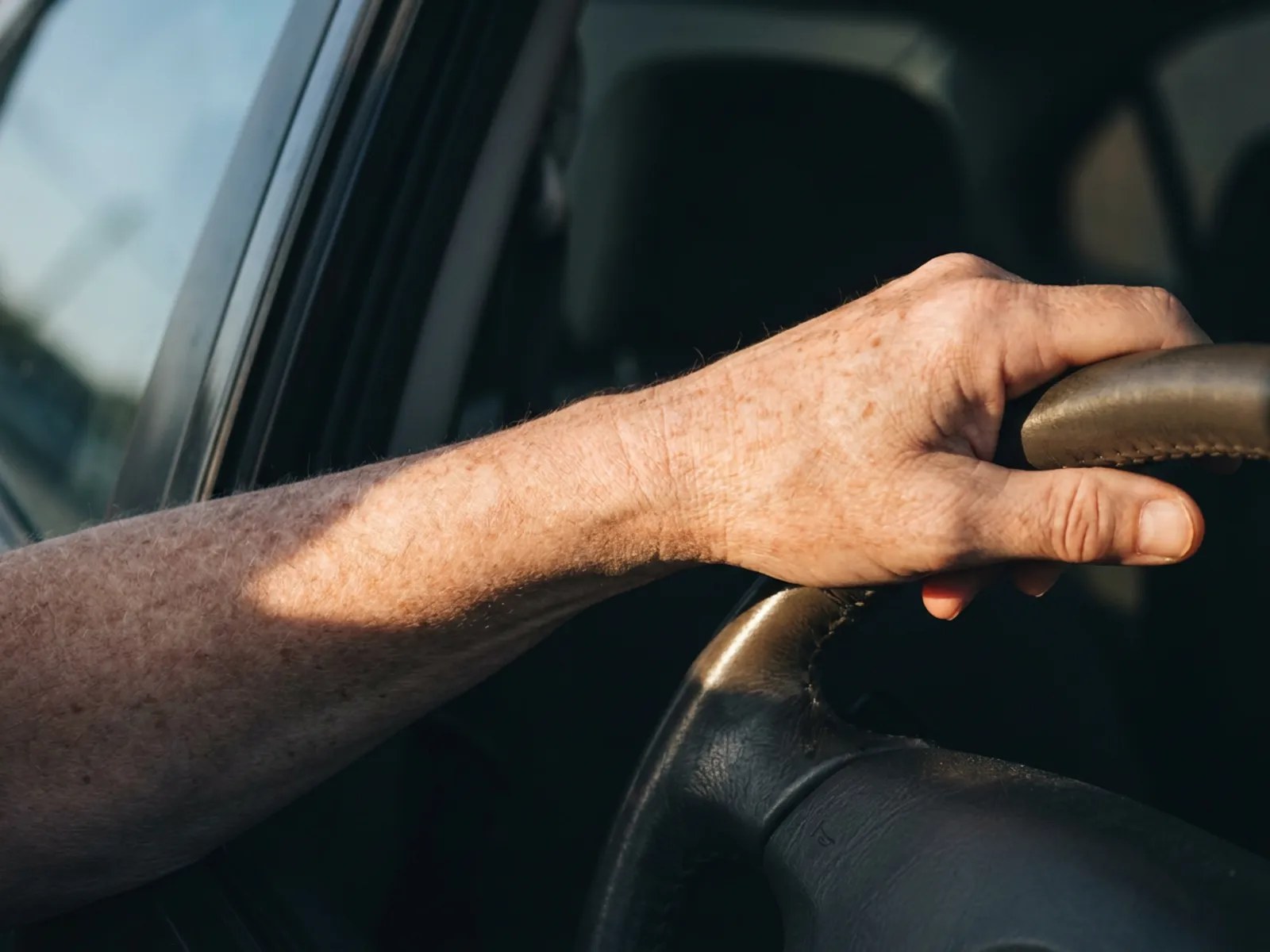
It depends on the glass and on how long you sit there. Glass blocks almost all UVB, the rays that cause sunburn, so burning through a closed window is very unlikely. It blocks only part of UVA, the rays linked to skin aging and to skin cancer. Windshields block most UVA. Side windows block less, and the amount varies a lot from car to car. Plain clear glass can also let some UVA through. You get less UV behind glass than outdoors, and no study has shown that sunscreen used only in the car or only indoors prevents skin cancer. For a short errand, this is not worth worrying about. For long or daily drives, or hours in direct sun by a window, especially after a skin cancer, protecting the window-side skin is reasonable. Follow your own doctor's instructions.
The short version: it depends on the glass and the time
Sunlight carries two kinds of ultraviolet light that reach your skin. UVB is the shorter wavelength. It causes sunburn, and it is what most people picture when they think of sun damage. UVA is the longer wavelength. It does not burn. It is the part of sunlight linked to the wrinkling and spotting of aging skin and, in laboratory studies, to the kind of DNA damage that leads to skin cancer.
Glass treats the two differently. A 2013 review put it simply: all types of commercial and automobile glass block the majority of UVB, while how much UVA gets through depends on the type of glass. In a bench experiment on glass of several types, every sample stopped UVB completely. In measurements inside cars, the windows passed only the longer UVA wavelengths. So you will almost never sunburn through a closed window. That is not the same as getting no ultraviolet light.
The honest answer to the question in the title is therefore: it depends. It depends on which glass is between you and the sun, and on how long you sit in the beam. The rest of this page gives the numbers behind that answer. None of the studies measured your car, your office, or your living room, and you cannot tell by looking what your glass blocks.
In the car: the windshield and the side window are not the same
A British study published in 2004 measured UVA passing through a selection of car glass. Its authors noted that windshields are made of laminated glass, while side and rear windows are usually not. Clear non-laminated glass let 62.8 percent of UVA through. Gray laminated glass let 0.9 percent through. Lamination cut UVA, and so did tint.
The best real-world numbers come from a 2016 study that measured UVA behind the windshield and behind the driver's side window of 29 cars from 15 makers, at dealerships in Los Angeles, model years 1990 to 2014. Windshields blocked 96 percent of UVA on average, and every one blocked at least 95 percent. The driver's side window blocked 71 percent on average, but the spread ran from 44 percent to 96 percent, and only 4 of the 29 cars had a side window that blocked more than 90 percent. The chart shows the two results side by side. The study does not say how the cars were chosen or whether any windows were tinted, so the numbers describe those cars, not yours.
Two more points about cars. Opening the window changes everything: in measurements on dummies in seven German cars, the sunburn-weighted dose on the arms was 3 to 4 percent of the outdoor dose with the windows shut, 25 to 31 percent with them open, and 62 percent in an open convertible. Those figures count the burning rays, not UVA, so they do not mean a closed window blocks 96 percent of UVA. And glass changes over time: the 2013 review noted that newer safety rules may put laminated glass in more side windows, so a newer car may block more UVA than the cars in the 2016 study. It may not. You cannot tell by looking.
Figure
How much UVA car glass blocked in one study of 29 cars
Each bar is the average share of outdoor UVA that the glass stopped. The thin dark line shows the lowest and highest car measured, not a confidence interval.
Only 4 of the 29 cars (13.8%) had a driver’s side window that blocked more than 90% of UVA.
Data: Boxer Wachler BS. Assessment of levels of ultraviolet A light protection in automobile windshields and side windows. JAMA Ophthalmology. 2016;134(7):772–775. Twenty-nine cars from 15 manufacturers at Los Angeles dealerships, model years 1990 to 2014 (average 2010); the study measured the front windshield and the driver’s side window only, and does not say how the cars were chosen or whether any windows were tinted. The 95% confidence intervals of the averages were 95.7% to 96.3% for windshields and 66.4% to 75.6% for side windows; the difference between the averages was 25 percentage points (reported as 25%; 95% CI 21% to 30%; P < .001). Only 4 of the 29 cars (13.8%) had a driver’s side window that blocked more than 90%.
What this means: windshield blockage was consistently high, and side-window blockage was lower and varied widely from car to car. This is a measurement of the glass, not a dose to skin, and it cannot describe your car; you cannot tell by looking which kind of side window you have. This figure is our own drawing of the published numbers.
See the numbers as a table
| Glass | Average UVA blocked | Lowest to highest car | 95% confidence interval |
|---|---|---|---|
| Front windshield | 96% | 95% to 98% | 95.7% to 96.3% |
| Driver's side window | 71% | 44% to 96% | 66.4% to 75.6% |
| Difference, windshield minus side window | 25 percentage points | not reported | 21% to 30% (P < .001) |
| Side windows blocking more than 90% | 4 of 29 cars (13.8%) | not applicable | not reported |
Do drivers really get more skin cancer on the window side?
Earlier research had already reported more sun damage and precancers on the left side of the face, as a 2010 US study noted. The research supports the observation, with limits. In a study of 148 truck drivers in Turkey, where the driver sits on the left as in the United States, seborrheic keratoses were more common on the driver's side of the face and sun spots, called solar lentigines, on the driver's side ear. In drivers over 40, or with more than ten years of driving, actinic keratoses, the rough precancerous spots, were more common on the driver's side too. One published case describes a woman with severe one-sided sun damage who had worked for 15 years in the same room, facing the same window.
Skin cancers show a smaller tilt. At one US academic Mohs surgery center, 52.6 percent of skin cancers were on the left side of the body and 47.4 percent on the right, a difference that did not quite reach statistical significance overall, though it did in men; among 42 melanomas in situ, 31 were on the left. In the US cancer registry, among 82,587 melanomas of the face, arm, or leg, 53 percent of arm melanomas, 51 percent of face melanomas, and 52 percent of leg melanomas were on the left, as were 55 percent of arm Merkel cell carcinomas. The registry had no information about driving. In one UK hospital, where the driver sits on the right, basal cell carcinomas of the face and scalp were 52 percent right-sided and squamous cell carcinomas 54 percent right-sided; the authors wrote that the finding could contribute to the literature on driving, not that it proved the link. If you have had a basal cell carcinoma or a squamous cell carcinoma on the window side, this is the pattern your dermatologist has in mind.
The honest reading is consistent with driving, not proven to be caused by it. A 2007 study of six cancer registries found more melanomas on the left than the right in every one, including England, Scotland, and Australia, where the driver sits on the right; Scotland had the largest left-sided excess of all. The authors suggested differences in sun exposure, or an asymmetry in how pigment cells are laid down before birth. In the US registry, melanomas on the legs, which are mostly shaded while driving, also tilted left. Our reading of these studies is that the window-side pattern is clearer for the slow-growing cancers and precancers of long, steady sun exposure, actinic keratoses, basal cell carcinoma, and squamous cell carcinoma, than for melanoma, and that driving is a plausible contributor rather than a proven cause. Cancers occur on both sides, and the passenger side gets sun too.
Why UVA matters even if you never burn
The glass question matters because UVA damages skin without a burn. In a laboratory study of human squamous cell carcinomas and precancerous solar keratoses, the pattern of DNA damage typical of UVA was found mostly in the basal layer, the deepest part of the outer skin, where the cells that renew the skin live. The damage typical of UVB sat higher up. The authors concluded that the longer ultraviolet wavelengths are an important cause of cancer in that layer. That is mechanism, not a measurement of risk from a car window, and it does not say how much UVA through glass adds to anyone's risk.
Our companion page, Is There Such a Thing as a Safe Amount of Sun?, covers the bigger picture: ultraviolet light is a proven human carcinogen, sunburns and intense on-and-off sun drive melanoma, years of steady exposure drive squamous cell carcinoma and the visible aging of skin, and daily sunscreen reduced squamous cell carcinomas and skin aging in a randomized trial. Nothing on this page changes that. UVA through glass is a smaller, steadier version of the same exposure.
Indoors by a window
Here the research is thinner. The best data are bench tests of glass, not measurements at anyone's desk. In a 2009 experiment, smooth ordinary glass let 74.3 percent of UVA through and blue glass let 56.8 percent through, while laminated glass, green glass, and one sunlight-control film blocked all of it, and every glass blocked UVB completely. The 2004 British study found 62.8 percent of UVA passing through clear non-laminated glass. Neither study tested household windows, and newer coated windows may block more. You cannot tell by looking, and a dark tint is not a guide: the blue glass passed more than half.
What indoor exposure adds up to depends on hours in direct sun. A Danish study fitted 285 volunteers with personal dosimeters for a year. Indoor workers received about 132 standard sunburn doses over the year and gardeners 224, and only the gardeners got most of their dose on working days, which suggests that for indoor workers most of the year's ultraviolet light came from time off, outdoors. Those meters counted sunburn-weighted light, not UVA, so they say little about a window seat. The searches for this article found no study that measured UVA at an ordinary desk or sofa, and no trial of sunscreen used only indoors.
The practical message is proportionate. Ordinary indoor light, away from a direct sunbeam, is a low priority. Hours every day in direct sun through a clear window, on the same side of the face or the same arm, is a real exposure, and the office case above shows what years of it can do. People with sun-sensitive rashes such as polymorphic light eruption may flare behind clear glass: the British study calculated that a UVA dose enough to trigger the rash in some patients could pass through clear non-laminated glass in 30 minutes, but would take 50 hours through gray laminated glass. That calculation is about a rash, not cancer risk.
What the sunscreen trials did and did not test
The strongest evidence that sunscreen prevents skin cancer comes from a trial in Nambour, Australia, that assigned 1,621 adults to daily sunscreen on the head, neck, arms, and hands, or to use sunscreen as they liked. Daily use led to fewer squamous cell carcinomas, a tumor rate ratio of 0.61 with a 95 percent confidence interval of 0.46 to 0.81, and no significant change in basal cell carcinomas. The trial tested daily outdoor use in a subtropical climate. It did not test a car or a window seat, and no trial has. The companion page describes the trial's later melanoma and skin-aging results.
So the case for sunscreen behind glass is reasoning, not trial evidence: UVA gets through some glass, UVA damages skin, a broad-spectrum sunscreen blocks UVA, and the benefit of blocking an exposure is likely to scale with how much of it you get. That reasoning is why many dermatologists think protection is sensible for long drives and for people at higher risk, and why we do too. It is also why a short errand is not worth worrying about.
A proportionate plan, and who it matters most for
This is general education, not a plan for you, and the surgeon or dermatologist who treats you may give different advice. With that said, here is how the evidence sorts out:
- A short drive or an errand: not worth worrying about. The exposure is small, and no study suggests it changes anyone's risk.
- Long or daily drives: the window-side arm, hand, neck, and face get the most. The British study's authors list long sleeves, keeping the arm below the window line, and tinted or laminated windows as helpful. Keeping the windows up on sunny days cuts the dose sharply. A broad-spectrum sunscreen, SPF 30 or higher, on the exposed side is the usual advice; broad-spectrum means it covers UVA as well as UVB.
- Hours each day in direct sun by a window, at a desk or a favorite chair: move the chair, add a shade or blind, or use a UV-blocking window film; one film tested on the bench blocked UVA completely. Sunscreen on the exposed side is reasonable if the sun cannot be moved.
- A history of skin cancer, a weakened immune system, or a sun-sensitive condition: the companion page explains why sun protection stays essential for the highest-risk group, and behind glass is no exception. Some medicines also make skin more sensitive to light; ask your doctor or pharmacist.
- Car window film or tint: check your state's rules before adding anything to car windows, and judge a film by its stated UV blockage, not its shade. Darkness is not a guide to UVA protection.
If you have a healing wound or a new scar
Ask the surgeon who treated you before putting sunscreen on a healing surgical wound or a new scar. A sleeve, a hat, or a dressing may be what they prefer while it heals, and the timing differs from surgeon to surgeon and wound to wound. Follow the instructions from the surgeon who treated you. And whatever side you drive on, point out any new or changing spot, wherever it is, at your skin check.
This page is general education and should not be construed as medical advice. The studies described here measured particular cars, glass samples, and populations, not your car, your windows, or your skin, and the right amount of protection depends on your history, your skin, and your hours in the sun. Always consult your own doctor, and if you have a healing surgical wound, follow the instructions of the surgeon who treated you before putting anything on it. If we treated you and you have a question about sun protection after surgery, call us at (972) 378-0620.
Common questions
Answers reflect the general case — a physician who can see the wound always beats a page that cannot.
Selected peer-reviewed literature
The data behind the answer.
- Boxer Wachler BS. Assessment of levels of ultraviolet A light protection in automobile windshields and side windows. JAMA Ophthalmology. 2016;134(7):772–775. (opens in new tab)
- Hampton PJ, Farr PM, Diffey BL, Lloyd JJ. Implication for photosensitive patients of ultraviolet A exposure in vehicles. British Journal of Dermatology. 2004;151(4):873–876. (opens in new tab)
- Duarte I, Rotter A, Malvestiti A, Silva M. The role of glass as a barrier against the transmission of ultraviolet radiation: an experimental study. Photodermatology, Photoimmunology & Photomedicine. 2009;25(4):181–184. (opens in new tab)
- Almutawa F, Vandal R, Wang SQ, Lim HW. Current status of photoprotection by window glass, automobile glass, window films, and sunglasses. Photodermatology, Photoimmunology & Photomedicine. 2013;29(2):65–72. (opens in new tab)
- Moehrle M, Soballa M, Korn M. UV exposure in cars. Photodermatology, Photoimmunology & Photomedicine. 2003;19(4):175–181. (opens in new tab)
- Kavak A, Parlak AH, Yesildal N, Aydogan I, Anul H. Preliminary study among truck drivers in Turkey: effects of ultraviolet light on some skin entities. Journal of Dermatology. 2008;35(3):146–150. (opens in new tab)
- Moulin G, Thomas L, Vigneau M, Fiere A. A case of unilateral elastosis with cysts and comedones: Favre-Racouchot syndrome [article in French]. Annales de Dermatologie et de Vénéréologie. 1994;121(10):721–723. (opens in new tab)
- Butler ST, Fosko SW. Increased prevalence of left-sided skin cancers. Journal of the American Academy of Dermatology. 2010;63(6):1006–1010. (opens in new tab)
- Paulson KG, Iyer JG, Nghiem P. Asymmetric lateral distribution of melanoma and Merkel cell carcinoma in the United States. Journal of the American Academy of Dermatology. 2011;65(1):35–39. (opens in new tab)
- Brewster DH, Horner MJ, Rowan S, Jelfs P, de Vries E, Pukkala E. Left-sided excess of invasive cutaneous melanoma in six countries. European Journal of Cancer. 2007;43(18):2634–2637. (opens in new tab)
- Tao C, Guenther E, Patel A. Lateralisation of basal cell and squamous cell carcinomas: a UK retrospective cross-sectional study. Journal of Plastic, Reconstructive & Aesthetic Surgery. 2026;114:180–182. (opens in new tab)
- Agar NS, Halliday GM, Barnetson RS, Ananthaswamy HN, Wheeler M, Jones AM. The basal layer in human squamous tumors harbors more UVA than UVB fingerprint mutations: a role for UVA in human skin carcinogenesis. Proceedings of the National Academy of Sciences. 2004;101(14):4954–4959. (opens in new tab)
- Thieden E, Philipsen PA, Heydenreich J, Wulf HC. UV radiation exposure related to age, sex, occupation, and sun behavior based on time-stamped personal dosimeter readings. Archives of Dermatology. 2004;140(2):197–203. (opens in new tab)
- Green A, et al. Daily sunscreen application and betacarotene supplementation in prevention of basal-cell and squamous-cell carcinomas of the skin: a randomised controlled trial. Lancet. 1999;354(9180):723–729. (opens in new tab)
If the sun has already left its mark
We treat basal cell carcinoma, squamous cell carcinoma, and melanoma every day, on whichever side they appear. If a spot is new or changing, we would rather see it early.
Basal Cell Carcinoma
The most common skin cancer — slow to spread, but destructive locally. Mohs offers the most precise removal.
Squamous Cell Carcinoma
The second most common skin cancer — treated promptly because it can spread. High-risk tumors get immunostained margin control.
Mohs Surgery for Melanoma
The most serious common skin cancer — treated here with same-day, margin-controlled Mohs surgery for appropriate cases.
Request a Consultation
A question about a spot that worries you?
Call us, or send an appointment request — requests receive a call back within one business day.
(972) 378-06206100 Windhaven Parkway, Plano, TX 75093 · Mon-Thurs: 7:30-4 | Fri: 10-2