How Do I Know If My Stitches Are Infected?
Medically reviewed by Gunjan Modi, MD, FAAD, FACMS, board-certified dermatologist and fellowship-trained Mohs surgeon · Updated October 2, 2026
The short answer
Early on, healing and infection can look alike. The difference is the direction of change. Normal healing brings a narrow band of pink at the edges, mild swelling, bruising, a little clear or blood-tinged fluid, and itching, and it tends to look and feel a little better each day. An infection gets worse instead: **redness that spreads, pain that increases after the second or third day, warmth, pus, fever, or edges that pull apart.** A third look-alike is an allergic rash from an antibiotic ointment, or sometimes from tape: itchy and bumpy, often with a sharp border where the ointment was applied. In published studies of skin cancer surgery, about 1 or 2 wounds in 100, or fewer, became infected. If you are not sure, call the surgeon who placed your stitches. Follow your own surgeon's instructions.
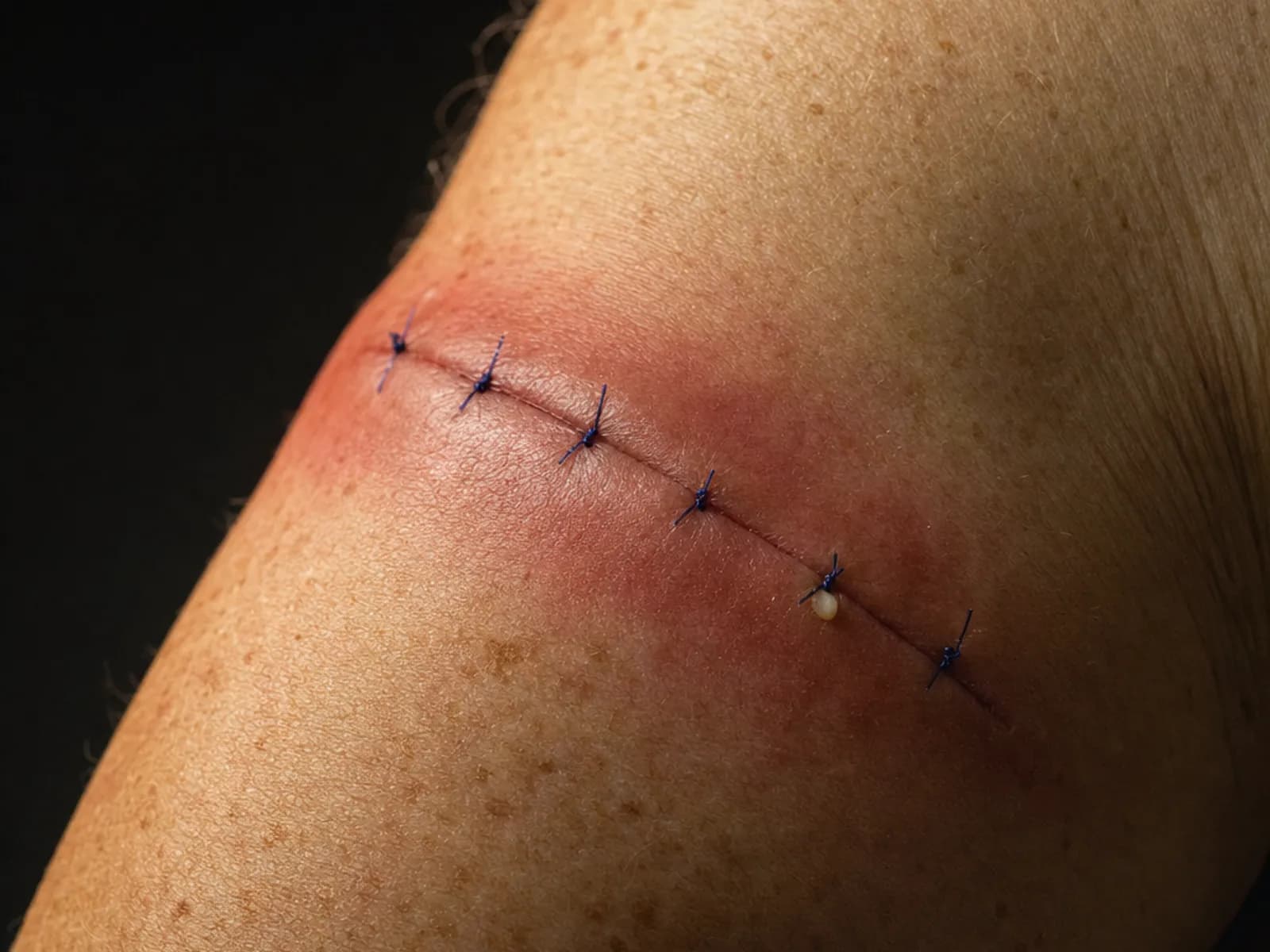
Three things that can look alike
In the first days after stitches go in, a wound that is healing normally and a wound that is starting an infection can look much the same. Both can be pink, puffy, and sore. The difference is usually the direction of change. A healing wound gets a little better each day. An infected wound gets worse.
There is a third look-alike that is easy to miss: an allergic rash from an antibiotic ointment put on the wound. It is itchy more than painful, and it tends to stop where the ointment stopped. This page describes all three, explains what doctors formally count as a wound infection, and lists the changes that should prompt a call to the surgeon who placed your stitches.
A few other things can also make a stitched wound look angry: a reaction to tape or adhesive, a buried stitch working its way to the surface, or a bruise or a collection of blood under the wound. That is not a complete list, and none of these can be sorted out by a description alone. When in doubt, call the surgeon who placed your stitches. Nothing on this page replaces their instructions.
What normal healing looks like
Surgeons expect a healing stitched wound to show a narrow band of pink or red right along the edges, mild swelling, and some bruising. A small amount of clear or blood-tinged fluid on the dressing in the first day or two is expected. As the wound closes it often itches. Tenderness is normal, and it tends to ease a little each day.
Underneath, healing moves through overlapping stages. The blood clots. The area becomes inflamed, which is the early redness and swelling. New tissue fills in. Then, over the following months, the scar remodels. These stages overlap, and you cannot tell which stage a wound is in by looking at it. The direction of change matters more than matching the wound to a chart.
Two more points. On brown or black skin, redness can be hard to see, so warmth, swelling, pain, and drainage carry more weight. And a small pimple or bump at one stitch hole can happen. Show it to the surgeon who placed your stitches; sometimes a stitch needs to come out early.
What an infection looks like
An infected wound stops improving and starts going the other way. The signs surgeons look for: redness that spreads outward from the wound instead of staying in a narrow band; pain that increases after the second or third day instead of easing; warmth over the wound; thick, cloudy, or yellow drainage, which is pus; fever; and wound edges that begin to pull apart. You do not need all of these. Any one of them, if it is new or getting worse, is a reason to call the surgeon who placed your stitches.
Surgeons do not all draw the line in the same place. In one small survey, 79 of 1,500 Mohs surgeons replied, and 79.7 percent of those who replied said warmth, swelling, redness, and pain together at about a week after surgery would count as an infection. They did not agree on timing. Not every infection is red or oozing, either. In one center's review of 676 wounds that had already been swabbed after Mohs surgery, infections caused by gram-negative bacteria showed less severe redness and less pus than the more usual gram-positive infections, and more swelling than wounds whose cultures grew nothing. New or worsening swelling or pain, even without much redness, is a reason to call the surgeon who placed your stitches.
The third look-alike: an allergic rash from ointment
In a published review of ointments used after surgery, neomycin, the antibiotic in Neosporin and other triple-antibiotic ointments, was the most common cause of allergic contact dermatitis in patients after surgery, and bacitracin was also a common culprit. The rash looks different from an infection if you know what to look for: it is itchy rather than painful, bumpy or blistered, and it often has a sharp border that matches where the ointment was applied, including skin away from the wound itself.
It is not rare. The same review estimated that an allergic rash from a topical antibiotic is about as common after skin surgery as infection itself: 1.6 to 2.3 percent of patients, against an infection rate of 1 to 2 percent. In a randomized trial of 922 dermatologic surgery patients, no one using plain white petrolatum developed an allergic rash, compared with 4 patients (0.9 percent) using bacitracin ointment. That difference was not statistically significant, but it points the same way.
If you suspect the ointment, do not simply switch products or stop everything on your own. Call the surgeon who placed your stitches and describe the rash; a look at it usually settles the question. For more on ointments and stitched wounds, see Can You Put Neosporin on Stitches? and Should You Put Neosporin on a Wound?.
How common is infection after skin cancer surgery?
Uncommon. In published studies of skin cancer surgery, about 1 or 2 wounds in 100, or fewer, became infected. A three-year study of 5,091 skin cancer surgeries at one Australian practice, done without preventive antibiotics, found an infection rate of 1.47 percent. For Mohs surgery, two prospective US studies of 1,000 patients each, also without preventive antibiotics, reported rates of 0.7 percent (8 of 1,115 tumors) and 0.91 percent (95 percent confidence interval 0.38 to 1.45 percent). A later review of 3,597 Mohs cases at another US center found 1.47 percent. Each study defined infection in its own way, so the numbers are not a contest.
In the largest study, 149 adverse events were reported among 20,821 Mohs procedures at 23 US centers (0.72 percent), and infection was the most common of those events (61.1 percent of them), ahead of wound separation and bleeding. These are other centers' results, not results from The Surgery Center at Plano Dermatology, and no study can predict the outcome of any one wound.
Which wounds get infected more often
The chance of infection varies with where the wound is and how it was closed. In the Australian series above, wounds below the knee, wounds closed with a skin graft, and wedge-shaped excisions of the lip or ear became infected far more often than simple stitched excisions or wounds on the face; flap repairs sat in between. The figure below shows the published numbers. Surgeons watch these wounds more closely, and some choose a preventive antibiotic for them; practices differ, and that is a decision for the surgeon who treated you.
Patient factors matter less than people expect, and the evidence is mixed. Studies disagree about diabetes: the same Australian authors, in a later and larger analysis of 7,224 lesions, found a higher infection rate in patients with known diabetes (4.2 percent versus 2.0 percent; odds ratio 1.66, 95 percent confidence interval 1.05 to 2.65), while the review of 3,597 Mohs cases found no significant difference (1.95 percent versus 1.35 percent). Blood thinners mainly raise the chance of bleeding; in the Australian series, people taking warfarin or aspirin had no higher infection rate. A collection of blood under a wound can sometimes become infected, though: three of the 11 infections in one of the Mohs studies were complications of hematomas. Do not stop or change a blood thinner on your own. Ask the doctor who prescribes it and your surgeon.
Figure
Which wounds became infected more often, in one large series
Share of wounds that became infected after skin cancer surgery at one Australian skin cancer practice (not a Mohs surgery series): 5,091 wounds over three years, with no preventive antibiotics. The study published percentages and counts but no confidence intervals for these groups, so the small groups are less certain than they look.
Data: Dixon AJ, Dixon MP, Askew DA, Wilkinson D. Prospective study of wound infections in dermatologic surgery in the absence of prophylactic antibiotics. Dermatologic Surgery. 2006;32(6):819–826. A three-year prospective study of 5,091 skin lesions, mostly non-melanoma skin cancers, on 2,424 patients at one Australian skin-cancer practice. A wound can appear in both groups: a flap on the face counts in the flap row and in the face row. Even in the highest groups, most wounds did not become infected. A later US Mohs series of 1,115 tumors (Maragh and Brown, 2008) recorded no infections in skin-graft closures or below-knee procedures, so the order is not fixed. These are one practice’s results, not results from The Surgery Center at Plano Dermatology, and not a prediction for any one wound. This figure is our own drawing of the published numbers.
See the numbers as a table
| Group | Infected wounds | Share |
|---|---|---|
| By type of procedure: Simple excision and closure (stitched straight across) | 16 of 2,974 | 0.54% |
| By type of procedure: Curettage (scraped, no stitches) | 3 of 412 | 0.73% |
| By type of procedure: Skin flap repair | 47 of 1,601 | 2.94% |
| By type of procedure: Wedge excision (lip or ear) | 3 of 35 | 8.57% |
| By type of procedure: Skin graft | 6 of 69 | 8.70% |
| By where on the body: Face (all procedures) | 18 of 2,209 | 0.81% |
| By where on the body: Below the knee (all procedures) | 31 of 448 | 6.92% |
| All 5,091 wounds in the study | count not printed in the abstract | 1.47% |
When to call the surgeon who placed your stitches
Most stitched wounds heal without trouble. This is a general list of reasons to call, not any one practice's after-hours protocol, and the person to call is the surgeon who placed your stitches, because they know how the wound was closed:
- Call the same day if redness spreads beyond the edges of the wound, or a red streak runs away from it.
- Call if pain increases after the second or third day instead of easing.
- Call if the wound becomes warm or newly swollen, even without redness.
- Call if there is thick, cloudy, or yellow drainage, or any pus.
- Call the same day if you have a fever or chills.
- Call if the wound edges open or a stitch comes loose.
- Call the same day if bleeding does not stop with firm, steady pressure.
- Call if an itchy, bumpy rash appears where ointment, tape, or a dressing touched the skin.
- Call if anything about the wound worries you. A short call is better than a week of wondering.
- If you have a fever with fast-spreading redness and cannot reach your surgeon, get urgent or emergency care.
What happens if it is infected
There is no published rule for how an infected stitched wound is treated or how long it takes to settle, and this page cannot tell you what your surgeon will do. In general, the surgeon will want to look at the wound. Depending on what they see, they may take a swab for culture, prescribe an antibiotic, open part of the wound to let it drain, or remove one or more stitches early. Sometimes they will do none of these and simply recheck in a few days.
Do not take out stitches yourself; your surgeon decides. And do not start or change any medicine or ointment for the wound without asking the surgeon who placed the stitches. The right treatment depends on the wound, the bacteria, and how the wound was closed, and the surgeon who placed the stitches is the person who can judge it.
This page is general education and should not be construed as medical advice. Not all stitches and not all sutured wounds are the same, and no description can replace an examination. Always consult your own doctor, the surgeon or clinician who placed your stitches, and follow their instructions. If we placed your stitches and you have a question about a healing wound, call us at (972) 378-0620.
Common questions
Answers reflect the general case — a physician who can see the wound always beats a page that cannot.
Selected peer-reviewed literature
The data behind the answer.
- Dixon AJ, Dixon MP, Askew DA, Wilkinson D. Prospective study of wound infections in dermatologic surgery in the absence of prophylactic antibiotics. Dermatologic Surgery. 2006;32(6):819–826. (opens in new tab)
- Maragh SL, Brown MD. Prospective evaluation of surgical site infection rate among patients with Mohs micrographic surgery without the use of prophylactic antibiotics. Journal of the American Academy of Dermatology. 2008;59(2):275–278. (opens in new tab)
- Rogers HD, Desciak EB, Marcus RP, Wang S, MacKay-Wiggan J, Eliezri YD. Prospective study of wound infections in Mohs micrographic surgery using clean surgical technique in the absence of prophylactic antibiotics. Journal of the American Academy of Dermatology. 2010;63(5):842–851. (opens in new tab)
- Hansen T, Gangal A, Hijab E, et al. Postoperative surgical site infection rate in patients with diabetes following Mohs micrographic surgery: a retrospective analysis. Journal of the European Academy of Dermatology and Venereology. 2022;36(6):927–931. (opens in new tab)
- Alam M, Ibrahim O, Nodzenski M, et al. Adverse events associated with Mohs micrographic surgery: multicenter prospective cohort study of 20,821 cases at 23 centers. JAMA Dermatology. 2013;149(12):1378–1385. (opens in new tab)
- Hanly AM, Daniel VT, Mahmoud BH. Results of a national survey on the definition of surgical site infections after Mohs micrographic surgery. Dermatologic Surgery. 2023;49(7):641–644. (opens in new tab)
- Hicks A, Mazumder A, Moody R, Kumanan K, Behshad R. Clinical characteristics of gram-negative surgical site infections in patients treated with Mohs micrographic surgery: a retrospective analysis. Dermatologic Surgery. 2023;49(11):981–984. (opens in new tab)
- Smack DP, Harrington AC, Dunn C, et al. Infection and allergy incidence in ambulatory surgery patients using white petrolatum vs bacitracin ointment: a randomized controlled trial. JAMA. 1996;276(12):972–977. (opens in new tab)
- Heal CF, Banks JL, Lepper PD, Kontopantelis E, van Driel ML. Topical antibiotics for preventing surgical site infection in wounds healing by primary intention. Cochrane Database of Systematic Reviews. 2016;11:CD011426. (opens in new tab)
- Sheth VM, Weitzul S. Postoperative topical antimicrobial use. Dermatitis. 2008;19(4):181–189. (opens in new tab)
- Dixon AJ, Dixon MP, Dixon JB. Prospective study of skin surgery in patients with and without known diabetes. Dermatologic Surgery. 2009;35(7):1035–1040. (Same authors as the 2006 series.) (opens in new tab)
- Reinke JM, Sorg H. Wound repair and regeneration. European Surgical Research. 2012;49(1):35–43. (opens in new tab)
- Schwartzman G, Khachemoune A. Surgical site infection after dermatologic procedures: critical reassessment of risk factors and reappraisal of rates and causes. American Journal of Clinical Dermatology. 2021;22(4):503–510. (opens in new tab)
If a spot will not heal
A wound that never quite closes is one of the ways skin cancer first announces itself. Diagnosing and removing skin cancer is what this practice does all day, every day.
Basal Cell Carcinoma
The most common skin cancer — slow to spread, but destructive locally. Mohs offers the most precise removal.
Squamous Cell Carcinoma
The second most common skin cancer — treated promptly because it can spread. High-risk tumors get immunostained margin control.
Mohs Surgery for Melanoma
The most serious common skin cancer — treated here with same-day, margin-controlled Mohs surgery for appropriate cases.
Request a Consultation
A question about a spot that worries you?
Call us, or send an appointment request — requests receive a call back within one business day.
(972) 378-06206100 Windhaven Parkway, Plano, TX 75093 · Mon-Thurs: 7:30-4 | Fri: 10-2