Steri-Strips: When Do They Come Off, and Can I Remove Them Myself?
Medically reviewed by Gunjan Modi, MD, FAAD, FACMS, board-certified dermatologist and fellowship-trained Mohs surgeon · Updated October 2, 2026
The short answer
Adhesive strips (Steri-Strips is one brand) are meant to loosen and come off on their own as the skin heals. We found no trial that sets a best day. Two patient leaflets, not written for skin cancer surgery, give different times: one says 5 to 7 days if the wound has healed, the other says within two weeks. **Your surgeon's instructions decide.** That includes whether you may take them off at home or should leave them for a visit. If a strip falls off early, look at the wound, not the strip. Call your surgeon's office if the edges pull apart, if the wound keeps bleeding or drains, or if redness, swelling or pain gets worse. If you are not sure, call. This page is general education. Follow the instructions from the surgeon who treated you.
What the strips are doing on your wound
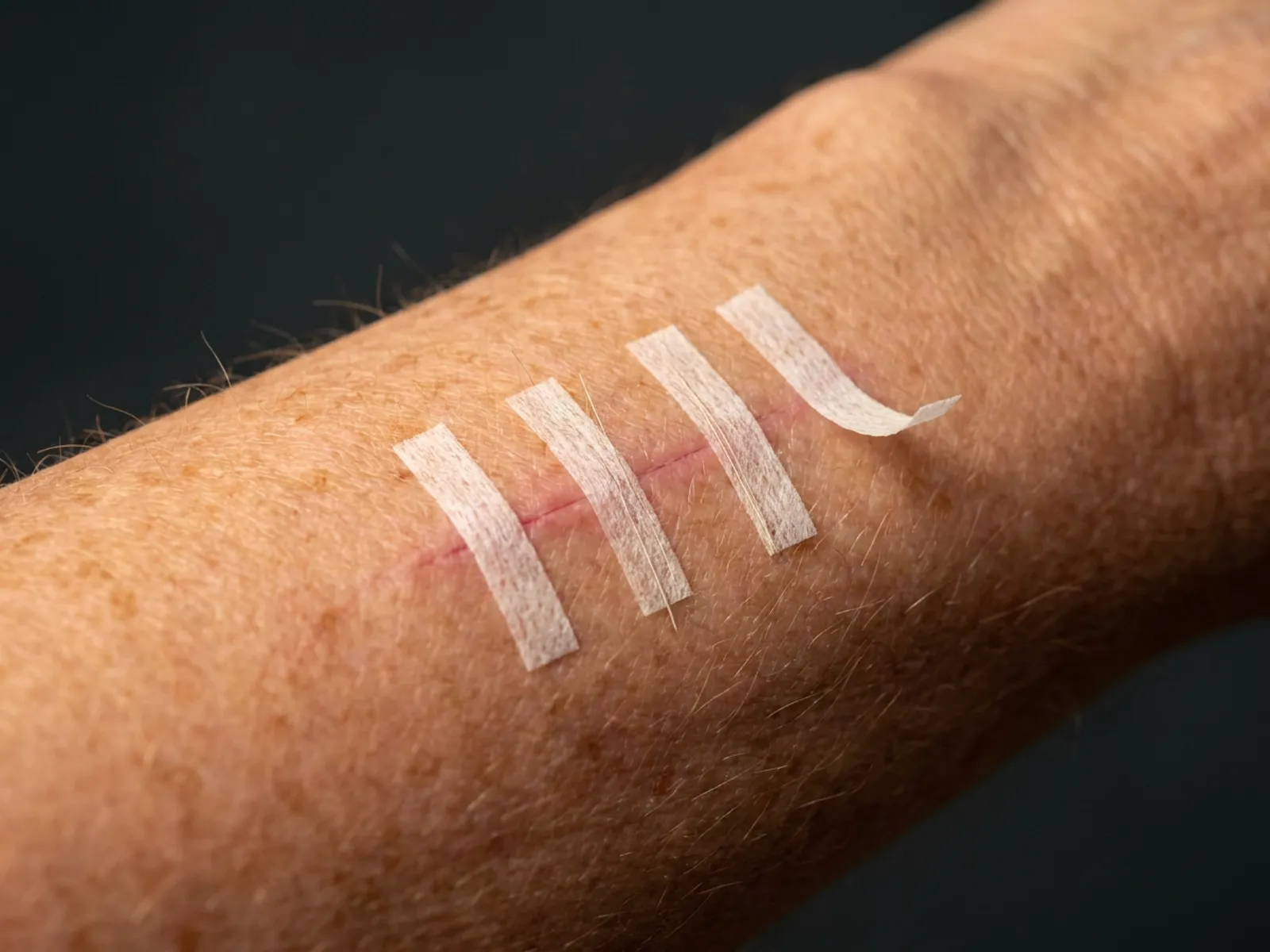
Adhesive skin-closure strips (Steri-Strips is the best-known brand) are thin strips of tape laid across a wound to hold the skin edges together. Surgeons use them in two main ways at the time of surgery. For a small wound with little pull on it, the strips can be the whole closure. For a larger wound, the surgeon closes the deeper layer with stitches under the skin and then lays strips across the surface line, sometimes in place of a top row of stitches.
Both approaches have been compared in trials. In a randomized trial of 38 cheek repairs after skin cancer removal, half of each wound was closed with a full layered stitch closure and the other half with buried stitches plus adhesive strips. A blinded evaluator found no difference in scar contour, redness, or overall appearance between the two halves; the patients had a mean age of 68. In another randomized trial, 48 skin-cancer surgery wounds at least 3 cm long were closed with buried stitches, and strips were added over one half of each wound. At three months no clear difference was found in the scar, whether judged by blinded observers (score 12.3 versus 12.9, P = .32) or by the patients themselves (14.0 versus 14.7, P = .39), and scar width was 1.1 mm on both halves. A laboratory test on skin from cadavers found that incisions closed with a continuous stitch run just under the surface held far more pulling force than incisions closed with strips alone, and that adding strips over the stitch made no significant difference. That was not a test of healing wounds. The point is that when stitches lie under the skin, the stitches carry the load; surgeons still add strips to steady the surface line, cover it, or hold a dressing in place.
Across many kinds of surgery, a pooled analysis of 12 randomized trials (1,317 incisions in 1,023 patients) compared strips with stitches and other closures. The one clear difference it found was less redness around wounds closed with strips. The trials were small and differed a lot from one another, and most were not skin-cancer surgery. One later randomized trial, at laparoscopic port sites, found that wound edges separated more often when strips were the only closure than with either kind of stitch. Surgeons choose a closure to fit the wound in front of them, and different surgeons make different choices. If you are curious why yours used strips, ask.
When do Steri-Strips come off?
We found no trial that tested one removal day against another. What exists is advice from hospitals and clinics, and that advice differs. A children's emergency leaflet from Guy's and St Thomas' in London, written for cuts closed with strips alone and now past its stated review date, says that after 5 to 7 days, if the wound has healed and the strips have not fallen off, they can be removed by soaking in water and carefully rolling from both ends. The Cleveland Clinic's incision-care page says the strips will fall off on their own within two weeks, and that after two weeks any remaining strips can be gently removed.
Neither page is a research study, neither was written for skin cancer surgery, and the two do not agree. They do agree on one thing: the strips are designed to loosen and come away on their own. The date on your own surgeon's instruction sheet is the one that counts. It reflects where the wound is, how it was closed, and how much pull is on it. If you were not given a date, call and ask.
Can I remove Steri-Strips myself?
Only if the surgeon who treated you said you may. Some surgeons want to see the wound at a visit and take the strips off there. Others tell patients to leave the strips alone until they fall off, or to remove them at home on a set day. All of these are normal practice, and none is wrong.
There is a reason not to pull. A consensus statement from a panel of 23 wound-care experts, funded by an unrestricted grant from 3M, the maker of Steri-Strips, describes skin injury from medical adhesives as a common but under-recognized problem that comes from poor application or removal technique. Older, thinner skin tears more easily, and so does skin on blood thinners. The maker's own guide tells clinicians to peel slowly, low to the skin, toward the wound, while holding the skin down, because pulling at an angle tugs on the skin surface.
That is the reason, not a set of steps. If your surgeon has told you to remove the strips at home, ask the team to show you how before you leave the office. If a strip is still firmly stuck on the day you were told to remove it, or you are not sure the wound is ready, call rather than pull.
Steri-Strips falling off early: after 1 day, 3 days, or sooner than you expected
This is the question people search most, and the honest answer is that no study has looked at it. As of October 2026 we found no trial of strips that came off on day 1 or day 3, and none that compares re-taping with leaving the wound alone. So no one can tell you from research whether a strip that fell off early matters. What matters is underneath: whether the wound edges are still together, and whether there is any bleeding, drainage, or gap. A strip that falls off is not, by itself, a wound that has opened. A wound with a gap, or one that is bleeding or draining, needs a call whether or not the strips are still on.
What the strips were doing depends on how your wound was closed, and you may not know. If stitches lie under the skin, they carry the load and the strips were steadying the surface. If the strips are the only closure, they are the closure. Skin grafts and flaps follow their own rules. If your wound was repaired with a graft or a flap, or the strips were placed on the day your stitches came out, call before doing anything about a loose strip. If you do not know how your wound was closed, call.
Do not put household tape or glue on the wound. If a strip has come off and you think it needs replacing, call; the office can tell you whether it does and, if so, replace it with the right material.
Showers, ointment, and other things that loosen strips
Water is the usual reason strips lift, and advice on showering differs from one surgeon to the next. The Cleveland Clinic page says you can wash or shower with strips in place, pat dry, and not pull, tug, or rub them. The London leaflet says keep the wound dry for the first 24 hours, then a brief shower or bath, and no soaking for 7 days. A Cochrane review found only one randomized trial on early bathing after skin surgery: 857 patients with stitched wounds, dressing off at 12 hours versus kept on for 48 hours, with infection in 8.5% versus 8.8% (risk ratio 0.96, 95% CI 0.62 to 1.48). The reviewers judged the trial at high risk of bias and called the evidence inconclusive. It did not involve strips. Follow your own surgeon's instructions on water.
Ointment is the other common cause. The London leaflet puts it plainly: do not use creams or ointments over the strips, as this can cause them to come off. If your surgeon asked you to apply ointment to a wound that also has strips, ask exactly where it should go. Our article Can You Put Neosporin on Stitches? covers ointment on a stitched wound, including why ointment and strips do not mix.
Loose, curling ends are the other thing that gets strips pulled off by accident. Both leaflets and the maker's guide say a lifted end may be trimmed. If your surgeon agrees, trim only the end that is hanging off intact skin, never across the wound line, and do not peel the strip to make trimming easier.
Redness, itching, or blisters under the strips
The adhesive on the strips, and the liquid adhesive some surgeons paint on the skin before placing them, can cause an allergic skin reaction. A 2021 review of contact dermatitis from medical adhesives notes that such reactions are being reported more often as adhesives replace stitches, and that clinicians need to tell a reaction apart from a more serious problem such as cellulitis, a spreading skin infection.
You should not try to tell the two apart yourself. New itching, a rash, or blisters under or around the strips are a reason to call the office so someone can look. So is redness that is spreading, swelling, or pain that is getting worse.
Taping a healed scar for weeks or months is a different thing
If you read about tape and scars, you may find trials where tape was worn for months; the figure below shows two of them. Those are about a different use of tape: taking tension off a scar after the wound has already healed, to lower the chance of a thick, raised (hypertrophic) scar. They say nothing about the closure strips placed at surgery.
In a randomized trial of 70 women after cesarean section, those assigned to apply paper tape to the scar for 12 weeks had no hypertrophic scars at 12 weeks, compared with 41% of the untreated group (P = 0.003). That is not a guarantee: only 39 of the 70 completed the study, one taped patient developed a hypertrophic scar and four developed stretched scars after the tape came off, and four taped patients had a brief rash under the tape. In one small randomized trial of limb scars, with tape worn 24 hours a day for six months, 80.5% of the untaped scars and none of the taped scars were abnormal at six months, an unusually large effect; the abstract does not give the number of patients. Silicone sheets are used the same way. A Cochrane review of 20 trials (873 people) found that silicone sheeting lowered hypertrophic scarring in people prone to it (risk ratio 0.46, 95% CI 0.21 to 0.98) but called the evidence weak and the studies highly susceptible to bias.
Whether a healed scar would benefit from taping or silicone, and for how long, is a question for the surgeon who treated you. It is a separate decision from when the strips placed at surgery come off.
Figure
Taping a healed scar for weeks: abnormal scarring, taped versus not taped
Two randomized trials that taped scars for weeks to months AFTER the wound had healed. They are not about the closure strips placed at surgery. Bars show the share of scars that became thick or abnormal.
Each bar is the share of scars in that group that became hypertrophic (Atkinson) or abnormal (Ilori), as printed in the abstract.
Data: Atkinson JA, et al. Plastic and Reconstructive Surgery. 2005;116:1648–1656, a randomized trial of 70 women after cesarean section (39 completed the study), paper tape applied for 12 weeks after the stitches came out; and Ilori OS, et al. Journal of Ayub Medical College Abbottabad. 2022;34:223–229, a randomized trial of limb scars after surgery, microporous tape worn 24 hours a day for six months; the abstract does not give the number of patients. In the Atkinson trial, one taped patient developed a thick scar and four developed stretched scars after the tape came off, and four had a brief rash under the tape. Results this large from small trials should be read with care. This kind of evidence is why some surgeons recommend taping or silicone on a scar later; ask your own surgeon whether it suits your scar. This figure is our own drawing of the published numbers.
See the numbers as a table
| Trial and time point | Outcome | Not taped | Taped |
|---|---|---|---|
| Atkinson 2005 | Hypertrophic scar at 12 weeks | 41% | None |
| Ilori 2022, 3 months | Abnormal scar at 3 months | 75.6% | 2.4% |
| Ilori 2022, 6 months | Abnormal scar at 6 months | 80.5% | None |
When to call the surgeon who treated you
Most wounds with strips on them heal without trouble. Call if you notice any of the following, and follow the warning-sign list on your own instruction sheet if it differs:
- The wound edges are pulling apart, or you can see a gap
- Bleeding that does not stop with gentle pressure
- Pus, cloudy drainage, or a bad smell from the wound
- Redness or swelling that is spreading beyond the wound
- Pain that is getting worse instead of easing
- Fever
- New itching, rash, or blisters where the strips are. This can be a reaction to the adhesive rather than an infection, and it needs a proper look to tell the two apart
- A strip has come off and you are not sure what to do
This page is general education and should not be construed as medical advice. Not all wounds and not all adhesive strips are used the same way: strips may be the whole closure, may sit over stitches under the skin, or may be placed when stitches come out, and the right care differs. Always consult your own doctor, the surgeon or clinician who treated your wound, and follow their instructions before removing, trimming, or replacing a strip. If we treated your wound and you have a question about a healing wound, call us at (972) 378-0620.
Common questions
Answers reflect the general case — a physician who can see the wound always beats a page that cannot.
Selected peer-reviewed literature
The data behind the answer.
- Gkegkes ID, Mavros MN, Alexiou VG, Peppas G, Athanasiou S, Falagas ME. Adhesive strips for the closure of surgical incisional sites: a systematic review and meta-analysis. Surgical Innovation. 2012;19(2):145–155. (opens in new tab)
- Plotner AN, Mailler-Savage E, Adams B, Gloster HM. Layered closure versus buried sutures and adhesive strips for cheek defect repair after cutaneous malignancy excision. Journal of the American Academy of Dermatology. 2011;64(6):1115–1118. (opens in new tab)
- Custis T, Armstrong AW, King TH, Sharon VR, Eisen DB. Effect of adhesive strips and dermal sutures vs dermal sutures only on wound closure: a randomized clinical trial. JAMA Dermatology. 2015;151(8):862–867. (opens in new tab)
- Yavuzer R, Kelly C, Durrani N, Mittal V, Jackson IT, Remine S. Reinforcement of subcuticular continuous suture closure with surgical adhesive strips and gum mastic: is there any additional strength provided? American Journal of Surgery. 2005;189(3):315–318. (opens in new tab)
- Singh PK, Das Poddar KK, Sasmal PK, Kumar P, Ali SM, Mishra TS. Comparison of laparoscopic port site skin closure techniques (CLOSA): transcutaneous suturing versus subcuticular sutures versus adhesive strips: a prospective single-blinded randomized control trial. Langenbeck's Archives of Surgery. 2023;408(1):228. (opens in new tab)
- Toon CD, Sinha S, Davidson BR, Gurusamy KS. Early versus delayed post-operative bathing or showering to prevent wound complications. Cochrane Database of Systematic Reviews. 2015;(7):CD010075. (opens in new tab)
- McNichol L, Lund C, Rosen T, Gray M. Medical adhesives and patient safety: state of the science: consensus statements for the assessment, prevention, and treatment of adhesive-related skin injuries. Journal of Wound, Ostomy and Continence Nursing. 2013;40(4):365–380. (opens in new tab)
- Thornton NJ, Gibson BR, Ferry AM. Contact dermatitis and medical adhesives: a review. Cureus. 2021;13(3):e14090. (opens in new tab)
- Atkinson JA, McKenna KT, Barnett AG, McGrath DJ, Rudd M. A randomized, controlled trial to determine the efficacy of paper tape in preventing hypertrophic scar formation in surgical incisions that traverse Langer's skin tension lines. Plastic and Reconstructive Surgery. 2005;116(6):1648–1656. (opens in new tab)
- Ilori OS, Oladele AO, Ilori OR, Onilede DA. Efficacy of microporous tape in the prevention of abnormal post-surgical scars among a Black population. Journal of Ayub Medical College Abbottabad. 2022;34(2):223–229. (opens in new tab)
- O'Brien L, Jones DJ. Silicone gel sheeting for preventing and treating hypertrophic and keloid scars. Cochrane Database of Systematic Reviews. 2013;(9):CD003826. (opens in new tab)
- Evelina London Children's Hospital, Guy's and St Thomas' NHS Foundation Trust. Caring for wounds closed with Steri-Strips. Patient information leaflet 5192/VER1, June 2021. (opens in new tab)
- Cleveland Clinic. Incision and surgical wound care: sutures, stitches, Steri-Strips and staples. Page updated November 15, 2023. (opens in new tab)
- 3M. Steri-Strip Adhesive Skin Closures: Application and Removal Pocket Guide. 3M, 2013 (document 70-2011-5474-0). (opens in new tab)
If a spot will not heal
A wound that never quite closes is one of the ways skin cancer first announces itself. Diagnosing and removing skin cancer is what this practice does all day, every day.
Basal Cell Carcinoma
The most common skin cancer — slow to spread, but destructive locally. Mohs offers the most precise removal.
Squamous Cell Carcinoma
The second most common skin cancer — treated promptly because it can spread. High-risk tumors get immunostained margin control.
Mohs Surgery for Melanoma
The most serious common skin cancer — treated here with same-day, margin-controlled Mohs surgery for appropriate cases.
Request a Consultation
A question about a spot that worries you?
Call us, or send an appointment request — requests receive a call back within one business day.
(972) 378-06206100 Windhaven Parkway, Plano, TX 75093 · Mon-Thurs: 7:30-4 | Fri: 10-2